


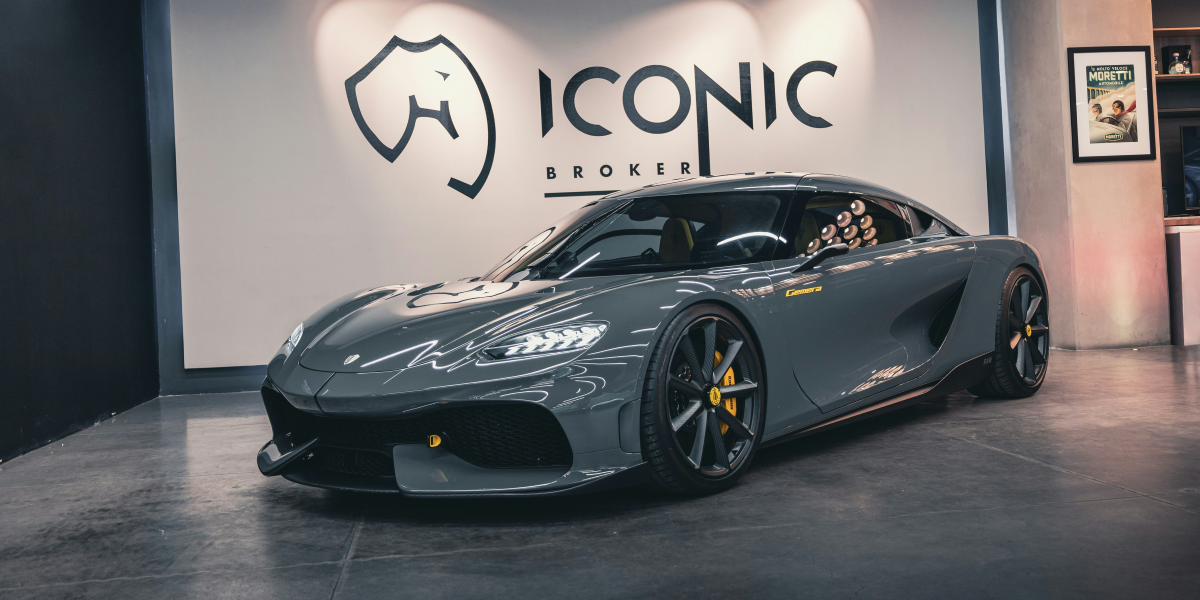
In a category defined by extremes, few names command the kind of reverence that Koenigsegg does. The Swedish manufacturer, founded in 1994 by Christian von Koenigsegg in the small town of Ängelholm, has spent three decades quietly turning what most of the auto industry considered impossible into showroom reality. From its first prototype to its current lineup of record-shattering machines, Koenigsegg has built its reputation not on volume or marketing, but on a willingness to engineer solutions that no other manufacturer has been willing to attempt.
A Vision Born in a Swedish Garage
Christian von Koenigsegg was 22 years old when he set out to build the kind of car he could not buy anywhere else. The original concept, sketched in the early 1990s, called for a mid-engine supercar that could match the performance of established names like Ferrari and Lamborghini while incorporating engineering ideas that those manufacturers had not yet attempted.
The first production car, the CC8S, arrived in 2002. It set a Guinness World Record for the most powerful production engine, and it announced the brand’s arrival on the world stage. More importantly, it established the template for what would follow: small production runs, obsessive attention to detail, and a willingness to design and manufacture nearly every component in-house rather than rely on the supplier networks that govern the rest of the industry.
The Engineering Philosophy
What separates Koenigsegg from its competitors is not just performance but how that performance is achieved. The company has consistently treated the hypercar as a research and development platform rather than a finished product.
The Agera RS, produced from 2015 to 2018, captured global attention in 2017 when it set five world records in a single day on a closed stretch of Nevada highway, including a 277.9 mph average top speed. The Jesko, introduced in 2019 and named after Christian’s father, was engineered with a top-speed target above 300 mph and a custom nine-speed Light Speed Transmission that shifts between any gear in any sequence without the linear progression of conventional gearboxes.
The Gemera, unveiled in 2020, represented a different kind of ambition entirely. Marketed as a four-seat “Mega-GT,” it combined a Tiny Friendly Giant three-cylinder engine with three electric motors to produce hybrid output figures that match traditional V8 hypercars while seating a family.
In-House Manufacturing as a Differentiator
Koenigsegg’s decision to manufacture nearly every component internally is unusual even by hypercar standards. The company designs and builds its own carbon fiber wheels, its own transmissions, its own engine control systems, and its own body panels. The result is a vertically integrated operation that allows rapid iteration on new ideas without waiting for outside suppliers.
This approach has produced patented technologies that are now studied across the industry. The Freevalve camless engine system, developed by a Koenigsegg sister company, replaces traditional camshafts with pneumatic actuators that allow each valve to be controlled independently. The Direct Drive transmission in the Regera eliminated the traditional gearbox entirely in favor of a hybrid system that uses electric motors to manage power delivery.
The Records and What They Represent
Koenigsegg’s record-setting runs are not marketing exercises. They are stress tests for engineering claims the company has made about its cars’ capabilities.
The Agera RS run in 2017 established a 277.9 mph two-way average that held the production-car top-speed record for years. The Jesko Absolut, the variant of the Jesko optimized for outright top speed, was engineered with a theoretical ceiling above 330 mph. The Regera, despite its single-speed Direct Drive setup, can accelerate from zero to 248 mph in under 22 seconds.
Each of these figures is tied to a specific engineering decision: the Regera’s lack of a conventional gearbox, the Jesko’s nine-speed Light Speed Transmission, the Agera RS’s twin-turbocharged V8 design. The records function as proof points for the engineering, not the other way around.
A Company Built on Scarcity
Koenigsegg produces fewer than 100 cars per year. Most models are sold out before production begins, often years in advance. Pricing routinely exceeds $3 million, and the limited-edition variants regularly clear $5 million on the secondary market.
That scarcity is part of the value proposition, but it also reflects the realities of how the company operates. Every car is hand-assembled. Every component is tested individually. The production cycle for a single vehicle can run several months, and the company has historically resisted pressure to scale.
The auto industry’s broader shift toward electrification has reached the hypercar segment, and Koenigsegg has been deliberate about how it responds. The Gemera’s hybrid architecture suggests one direction. The continued development of internal combustion technology through Freevalve and synthetic fuel research suggests another.
What is unlikely to change is the company’s appetite for engineering problems no one else wants to solve. Three decades after a 22-year-old started sketching a car in Sweden, that founding philosophy still defines the brand. In a category where most competitors chase the same benchmarks, Koenigsegg continues to set new ones — and then build the machines required to break them.