


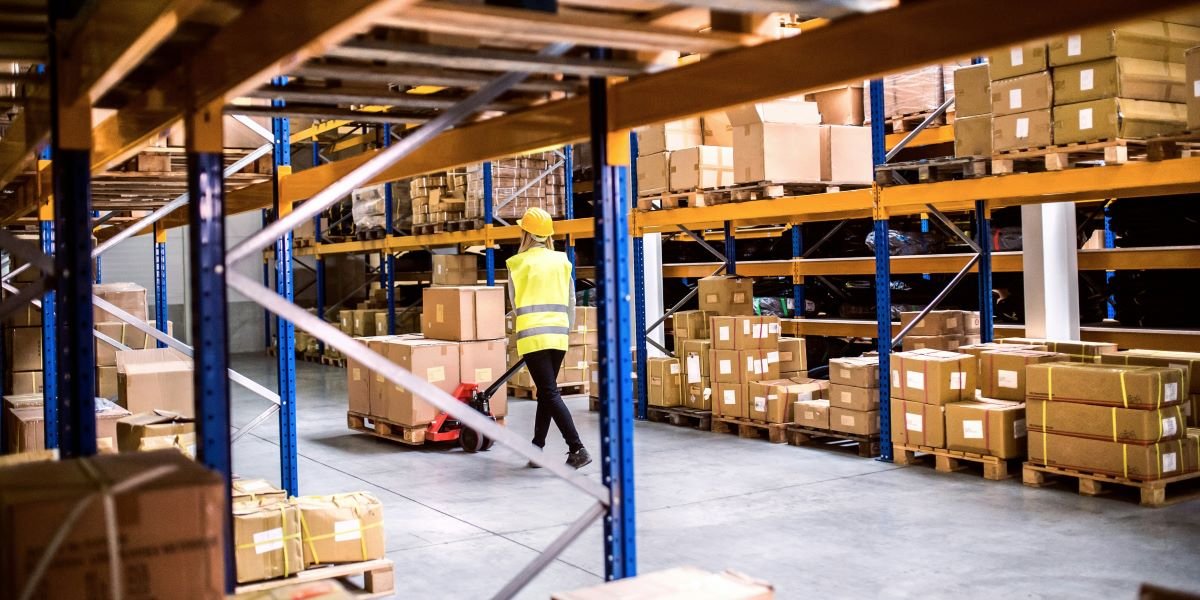
Amazon used a London stage this week to show off a warehouse robot that workers can talk to, the clearest sign yet of how far the company intends to push automation through its operations. The unveiling also drew a familiar contrast. As Amazon expands the machines that move its goods, it has spent the past year cutting the corporate roles that manage its business, a split that has come to define the U.S. labor story heading into the second half of 2026.
A Robot You Instruct in Plain Language
The company introduced a next-generation version of Proteus, its autonomous mobile robot, on June 4 at its Delivering the Future event at the Dartford fulfillment center east of London. The headline change is the interface. Rather than technical commands or a programming layer, employees direct the robot using plain conversational prompts, and Proteus determines the task priority, plots its own route, and decides timing. Scott Dresser, vice president of Amazon Robotics, described the machine as an assistant for moving material, telling the audience that a worker simply states what needs to be done.
The capability marks a step up from the original Proteus, first deployed in 2022 and currently running in 25 U.S. fulfillment centers, where it operates mainly in dock areas hauling carts that can weigh close to 400 kilograms. The new version is designed to work anywhere across a site, transporting containers from arrival to individual workstations. It is not shipping yet. Amazon is piloting it in its labs, with European deployment planned for the first half of 2027.
An $11 Billion Bet on Automated Logistics
Proteus arrived as one piece of a larger commitment. Amazon said it will invest more than €10 billion, roughly $11.6 billion, to expand and modernize its European fulfillment network over the coming years, paired with two other systems it is scaling across the region. Vulcan, which the company calls its first touch-sensitive robot, has moved from Spokane, Washington, to a facility in Hamburg, Germany. STARK, a collaborative tote-handling robot, debuted in Barcelona and is set to reach 15 European sites by 2027.
The company paired the robotics push with workforce messaging, pledging 25,000 new warehouse jobs across Europe and $1 billion toward employee upskilling through funded education and training. Amazon now operates more than one million robots globally, and it framed the new hardware as support for workers rather than a replacement for them.
The Corporate Cuts Behind the Contrast
That framing sits against a steep run of reductions on the white-collar side. In October 2025, Amazon cut about 14,000 corporate roles. In January 2026, it announced roughly 16,000 more, bringing the two waves to about 30,000 positions, near 10 percent of its corporate and tech workforce of roughly 350,000. Senior vice president Beth Galetti tied the moves to reducing bureaucracy and removing management layers, while CEO Andy Jassy has said for the past year that efficiency gains from generative AI would shrink the corporate headcount over time, with fewer people doing some current jobs and more doing new ones.
The pattern extends well beyond Seattle. Microsoft, Salesforce, and IBM have announced their own efficiency-driven cuts, and Meta has flattened teams as it leans on AI tooling. The throughline is consistent: spending is shifting toward chips, data centers, and AI talent, and away from the layered corporate structures built during the pandemic hiring surge.
What It Signals for the Workforce
The juxtaposition is the story. Amazon is adding warehouse jobs and automating warehouse tasks at the same time, while trimming the office roles that AI tools can now absorb. Economists remain cautious about attributing the cuts to AI alone, since over-hiring corrections and cost discipline are also at work, and Amazon itself has disputed the idea that automation reflects a single workforce strategy. What is not in dispute is the direction of investment.
For warehouse staff, a robot that takes plain-language instruction lowers the barrier to working alongside automation, which Amazon presents as a productivity aid. For corporate employees across the sector, the same AI advances are reshaping which jobs exist at all. The new Proteus will not reach floors at scale until 2027, and its near-term effect on U.S. employment is limited. Its longer-term signal is harder to discount. A machine that understands ordinary speech, paired with an $11 billion logistics commitment and a fresh round of corporate cuts, captures the bargain the largest technology firms are making in public, betting that automation expands output even as it narrows the kinds of work that built them. The coming jobs reports, not the demo reel, will show how that bargain lands.