


By: George Mac Allister
There is a version of leadership education that is almost entirely about control. Control variables. Reduce uncertainty. Execute the plan. Measure the outcome. Adjust as needed. It is a useful framework, and it is also incomplete in ways that become visible exactly when it matters most, when the unexpected arrives, and the plan stops applying.
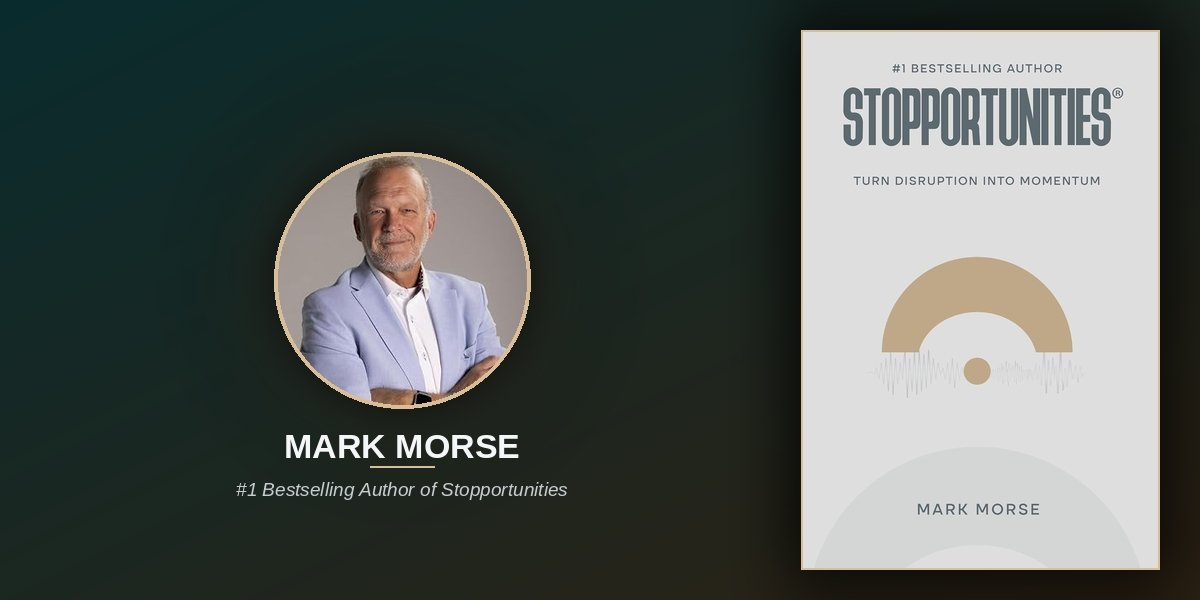
Mark Morse spent decades learning a different approach, one that absorbs uncertainty rather than eliminating it, that treats disruption as information rather than interference, and that knows the difference between holding the structure and following the music. He learned it on a jazz stage long before he applied it in a boardroom. And in Stopportunities: Turn Disruption into Momentum, he makes the case that what jazz teaches about leadership is something a purely business-centered framework almost always misses.
What Jazz Actually Teaches
A great jazz performance starts with a framework. Everyone in the band knows the song, the key, the tempo, the structure. The audience recognizes it. But within that structure, there is freedom to improvise, explore, and take the music somewhere no one necessarily planned. The question is what happens when another musician takes things in an unexpected direction.
In a rigid framework, you pull them back. In jazz, you give them space. You listen closely enough to recognize what they’re doing and respond. Sometimes the entire band follows, and together they discover something in real time that none of them could have created individually. But they never lose the structure completely. Eventually, everyone finds the path back.
Mark applies this directly to leadership in a creative professional services business built around people. You need a clear strategy and shared framework. You also need to create enough space for talented people to improvise, respond to what they’re hearing, and occasionally take the organization somewhere it didn’t plan to go. Business teaches leaders to control variables. Jazz teaches them to listen to them.
Disruption isn’t always something to eliminate. Sometimes it’s a new note entering the composition. The leader’s job is knowing when to hold the structure, when to let someone improvise, and when to follow the music somewhere new.
Faith as an Ingredient
Mark includes faith in the framework, and he is honest about the fact that it is an unusual ingredient in a business leadership book. He includes it anyway because for him it fundamentally changes what the pause actually is.
Strategy asks what to do. Psychology helps understand why a leader is reacting the way they are. Faith adds a deeper question: what is God asking me to see here, and is this right with my soul? The pause becomes a listening posture rather than just an analytical one. A space for prayer, discernment, and surrender. A recognition that not every answer has to be manufactured.
He points to Jesus as an example of intentional withdrawal. Even with enormous demands pressing from every direction, He stepped away to pray. Those pauses were recalibration, a stepping back from the noise to reconnect with purpose. Mark has experienced the same in his own leadership. Faith, he argues, offers something that strategy alone cannot: an anchor beyond the circumstances. The pause stops being only about what the leader is doing. It also becomes about what they believe is being done through them.
The Fermata
One of the most useful images in the book is the fermata, a musical symbol that tells the musician to hold a note. It doesn’t prescribe exactly how long. The conductor determines the duration based on what the composition and the moment require. The pause isn’t indefinite. It isn’t stillness for its own sake. It is holding the note long enough to give the moment meaning before the music continues.
Mark applies this directly to the question of how long a Stopportunity should last. There is no prescribed duration. It could be thirty seconds or several months. The pause has lasted long enough when it stops producing meaningful new insight and starts producing repetition. When you have assessed reality, understood what’s driving it, challenged your assumptions, and heard the perspectives that matter, more reflection doesn’t create more clarity. That is when PAUSE moves toward Strategize and Execute.
A Stopportunity should never become an excuse for indecision. The goal is not stillness. The goal is better movement. Just like a fermata, you hold the note long enough to give the moment meaning, and then the music has to continue.
If you’ve ever felt like the leadership books you’ve read don’t account for the human, the musical, or the spiritual dimensions of leading through chaos, Stopportunities by Mark Morse is available now on Amazon. This one does.