


By: Taylor Reid
In a world where disruption has become the norm—from volatile markets and political upheaval to AI revolutions and burnout epidemics—leaders are increasingly challenged. But according to Rob Kalwarowsky, the biggest battle isn’t out there. It’s within.
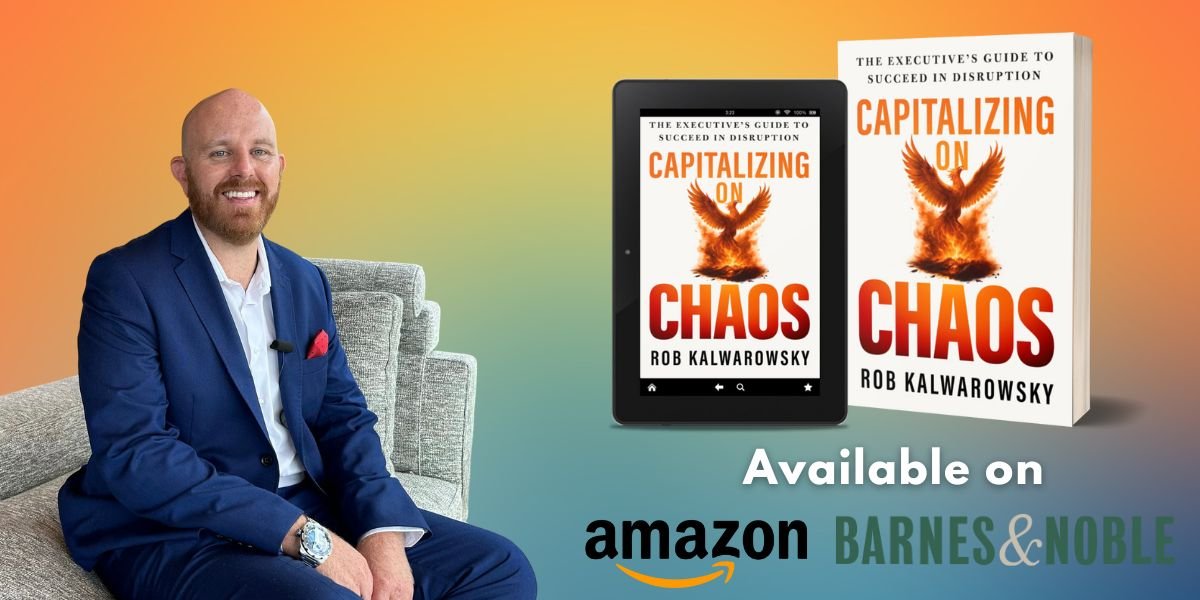
Kalwarowsky’s new book, Capitalizing on Chaos: The Executive’s Guide to Succeed in Disruption, isn’t just a survival guide for modern leaders—it’s a detailed exploration into the emotional and psychological architecture behind high performance. Drawing from his lived experience as an MIT-trained engineer, former NCAA athlete, and TEDx speaker, Kalwarowsky delivers a sobering but hopeful message: chaos is not just something we manage externally—it’s a state of mind we must learn to navigate from within.
“I had all the external markers of success—a great career, an incredible partner, financial stability,” Kalwarowsky shares. “But on the inside, I was struggling with depression, suicidal ideation, and panic attacks. My inner world was in turmoil, even when the outside wasn’t.”
It was this inner unrest—masked by external success—that ultimately inspired Capitalizing on Chaos. The book, released in 2025, offers a blueprint for building clarity, resilience, and power when the world (and your nervous system) feels like it’s challenging your peace.
Redefining Chaos: From External Disruption to Inner Turmoil
Kalwarowsky believes that most leadership models have been looking at chaos through the wrong lens. While traditional playbooks focus on controlling the uncontrollable—supply chains, market swings, economic shifts—Capitalizing on Chaos starts with the human operating system: the deeply embedded beliefs and subconscious scripts we carry through life.
“Have you ever seen a person perform at their best when everything was falling apart around them?” Kalwarowsky asks. “That’s not luck—that’s a cultivated mindset. Internally, they are calm even as the storm rages.”
In neuroscience terms, chaos triggers the fight-or-flight response—elevated cortisol, impaired decision-making, tunnel vision. For leaders, that means not just mental fatigue, but organizational fallout: poor judgment, reactive communication, and low morale.
Kalwarowsky teaches that by confronting the “war within”—the inner critic, the imposter syndrome, the perfectionist, the people-pleaser—leaders can gradually reclaim their clarity and show up with empathy, innovation, and steadiness even in uncertain times.
The Human Operating System: Upgrade Required
Central to Kalwarowsky’s framework is what he calls the “human operating system”—a set of internal patterns, beliefs, and mental programs, often inherited from childhood, that guide how we think, lead, and relate to others.
“It’s the software you run on, and for the most part, you’re unaware of what it’s doing,” he explains. “Would you let your phone or laptop run on an operating system from 30–50 years ago? That’s what most people are doing with their minds.”
This insight forms one of the book’s most compelling arguments: that we may be in need of a personal update.
By shining a light on outdated mental frameworks—like associating rest with laziness, equating self-worth with productivity, or fearing failure more than stagnation—leaders can work toward reprogramming themselves to operate with emotional maturity and mental agility.
Kalwarowsky’s process is grounded in both science and story. It’s deeply informed by his own healing journey and informed by frameworks from psychology, systems thinking, and performance coaching.
Resilience, Reimagined
“Resilience” has become a buzzword in boardrooms and Instagram quotes alike—but Kalwarowsky says we’re often misunderstanding what it really means.
“Resilience isn’t about being invincible; it’s about your ability to respond and recover when you get hit,” he says. “It’s not about ‘toughing it out’—it’s about developing emotional flexibility.”
He helps leaders identify the internal voices—like the inner judge, the victim, the perfectionist—that are burning up mental energy. When we stop fighting ourselves, he argues, we reclaim vast mental bandwidth to meet external challenges with grounded presence.
This self-leadership approach isn’t just a nice-to-have—it’s becoming a business imperative. In a high-pressure era defined by layoffs, restructuring, and digital acceleration, emotional volatility in leadership is no longer sustainable. Kalwarowsky positions emotional mastery not as therapy, but as a performance tool.
“In today’s high-stakes business world, can you afford to be the leader who folds in chaos?” he challenges. “What would it feel like if you were growing while your competition remains immobilized by fear?”
From Athlete to Advocate
Kalwarowsky’s insights aren’t theoretical. As a former elite athlete, he has lived through the mental training required to compete at the top level—and the psychological crash that can come when that identity crumbles.
“Performance was everything,” he recalls of his early years. “But I wasn’t taught how to manage my mental world. It nearly broke me.”
His training at MIT added intellectual rigor to his experience, but it wasn’t until he hit a personal low that his work took a new direction: inward.
“We’ve been told that success is about grinding harder. But what if the key is knowing when to stop grinding and start listening—to yourself, to your team, to your intuition?”
Leadership in the Era of Uncertainty
Capitalizing on Chaos isn’t just a book for CEOs or startup founders—it’s for anyone navigating uncertainty: parents, creatives, middle managers, solo entrepreneurs.
Its core message is that calm is the new power. In a world where chaos is constant, the advantage goes to those who can remain centered, adaptable, and human.
“My goal is to give people a roadmap,” Kalwarowsky says. “Because chaos isn’t going away—but you can still lead with courage, clarity, and compassion.”
Learn more about Rob Kalwarowsky, author of Capitalizing on Chaos, and his work at his official website: robkalwarowsky.com.