


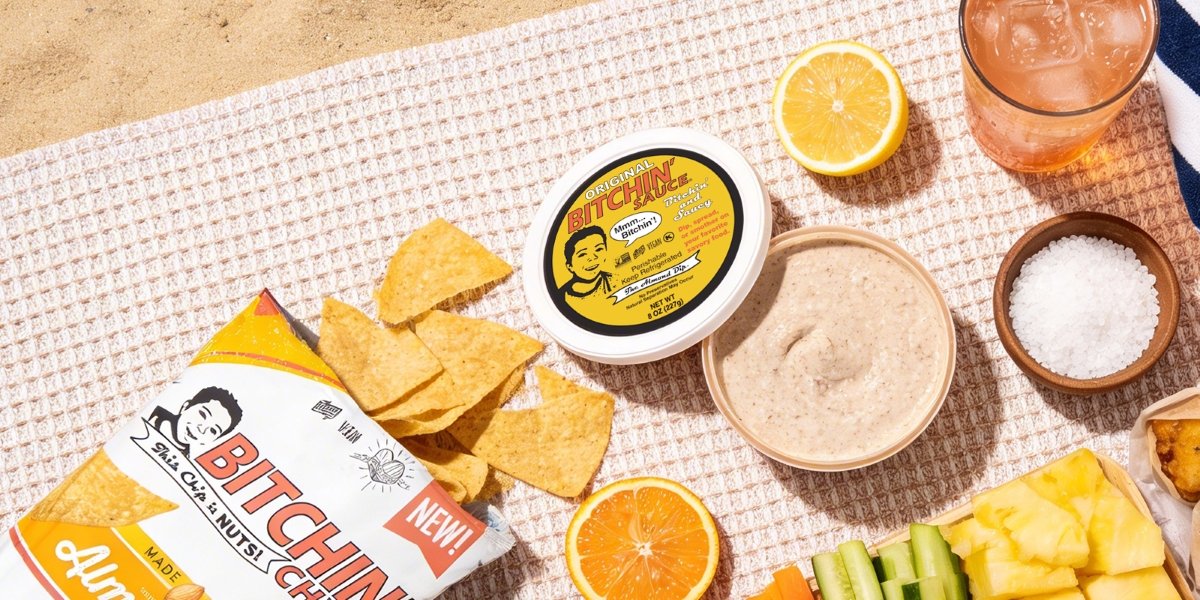
There is a test that happens at the Bitchin’ Sauce production facility. Before any batch ships, someone stands at the end of a physical ramp and watches the product flow. They check viscosity and texture by hand. No algorithm, no automated sensor. The batch ships or it does not based on what that person sees. Bitchin’ Sauce founder Starr Edwards has run the company that way since the San Diego farmers market days. That same logic now sits behind 15,000-plus retail locations across multiple continents, which tells you something about how far a core value can travel.
What Scaling Without Shortcuts Actually Means
Artificial preservatives, stabilizers, and gums are in the product. That sounds simple until you work out what it actually requires operationally at scale. Shelf windows get shorter. Cold chain management gets less forgiving. A single retailer’s temperature requirements can create logistical, operational, and profitability challenges that a synthetic additive would solve instantly. Bitchin’ Sauce still figures it out the old school way instead.
Producing that at the scale of Costco, Target, Kroger, Whole Foods, and Sprouts requires larger and more frequent production batches. With bigger runs comes more risk for loss, and a need for flawless quality control. Most companies solve these challenges by adding stabilizers, gums, acids, and preservatives to increase profit margin while reducing risk. Bitchin’ Sauce has not done that. Bitchin’ Sauce instead invested in production and quality assurance processes that have allowed the original farmers market recipe from 2010 to expand to customers worldwide.
The International Expansion
Distribution has expanded well past domestic borders. Bitchin’ Sauce has distribution in Australia, New Zealand, South Korea, China, and Mexico, with Canada online and the UK and Sweden in the pipeline. Every market gets the same product. No reformulation, no stabilizers added for longer transport times for exporting. The cold chain gets more complicated across international supply chains, and the company absorbs that cost rather than engineering around it.
The hand-check process travels with the product. Each batch still gets evaluated for viscosity and texture before it ships, whether it is heading to a Costco in California or a distributor in Seoul. That is not a differentiator that the company promotes heavily. It is just how the product gets made.
Retention Spending That Shows Up In The Product
The quality check that happens at the end of that ramp depends on experienced people. Losing institutional knowledge to turnover does not just affect culture. It affects consistency.
Bitchin’ Kids, the company’s childcare program, was built on one belief: no parent should have to choose between providing for their child and raising them. It started as free, on-site childcare at the production facility, a place where employees could check in with their kids during breaks or at lunch. What it built beyond the practical: children growing up alongside each other, parents becoming real friends, a workplace that felt more like a neighborhood than a job.
When the company shifted to a remote workforce, the program shifted too, becoming an annual non-taxable reimbursement of $7,500 per employee. Since 2019, Bitchin’ Sauce has offered over $1.6M through the program. Total benefits average $41,909 per employee annually.
Voluntary turnover runs 16.4%. About 40% of the team has crossed the four-year mark. That retention is the reason the ramp check means something. The team standing there has been doing it for years.
The Numbers Behind The Strategy
Over twenty rotating flavors come from a single almond base. The 2026 lineup adds Bitchin’ Chips (non-GMO corn tortilla chips made with almond oil), Salsacados™ (roasted tomato salsa with hand-scooped avocado pieces), a couple of refrigerated bean dip flavors, and a collab with The Good Crisp Company. Clean-label rules apply to all of it, same as the original.
Fifteen years in, the recipe and principles remain the same. The company built national retail presence without additives, built workforce retention without accepting the industry’s turnover math, and is now expanding a product lineup without touching the formula that started everything. At some point, that stops being a philosophy and starts being just how the company works, and, hopefully, an inspiration that not cutting corners can appeal to the mainstream.
About Bitchin’ Sauce
Bitchin’ Sauce is a family-owned, Carlsbad, California-based brand founded in 2010 by Starr and Luke Edwards. The company pioneered the almond-based dip category and has grown from local farmers’ markets to national distribution in 15,000+ retail locations, including Costco, Whole Foods, Sprouts, Target, and Kroger. Committed to clean-label manufacturing and a comprehensive employee benefits program, Bitchin’ Sauce remains a plant-based, better-for-you brand in the snacking category. Learn more at bitchinsauce.com.