



Picture a Tuesday night: a toothache that lingered all weekend can’t wait any longer. A woman in Los Angeles types “emergency dentist near me” into her phone. Within a minute, she has three names: two from the map at the top of the results, each with a star rating, and a third mentioned in a short AI-written summary above them. She skims a few reviews and books for the morning.
A few blocks away, a practice with fifteen years of loyal patients never came up. It will never know it was ruled out before anyone picked up a phone. That quiet elimination now sits at the center of how people choose local businesses, and local search habits are shifting in ways many owners haven’t noticed.
The Shortlist Now Forms Before the First Call
Comparison that once took phone calls and several website visits now happens on the results page itself. A customer sees a map, a row of star ratings, review snippets, and often a Google Business Profile with hours and photos, all before opening a single website.
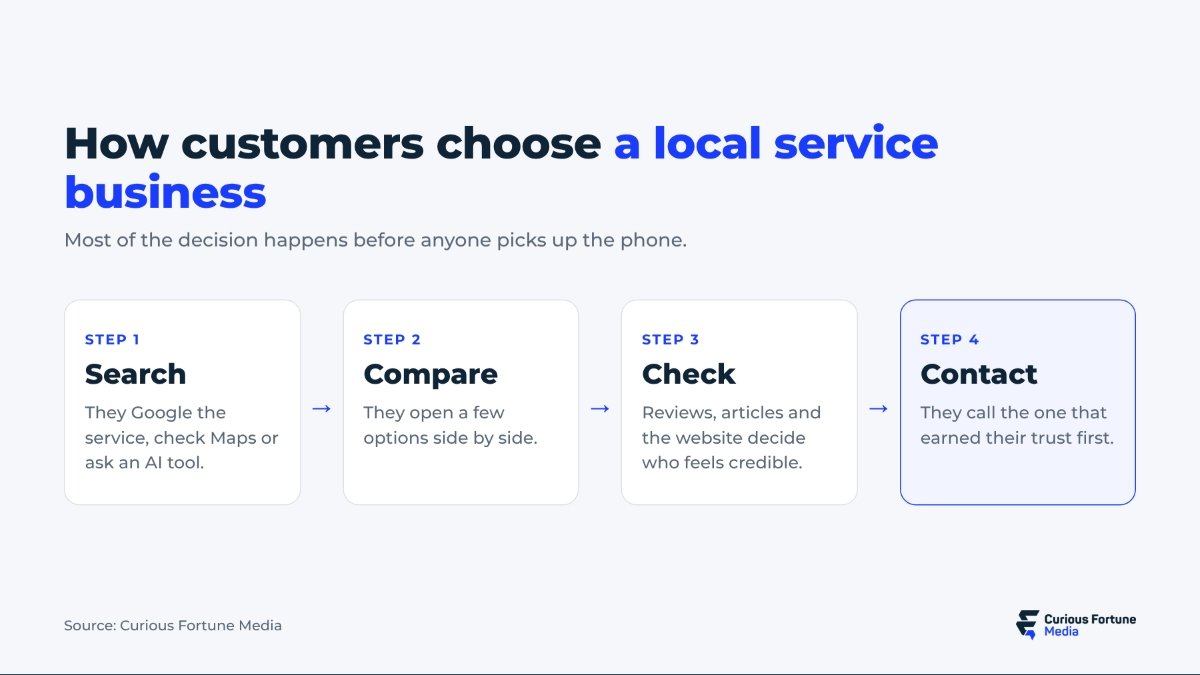
Online reviews and star ratings have become the first filter, not a final check. According to BrightLocal’s 2026 Local Consumer Review Survey, which polled about 1,000 US adults, 31% of consumers will use only businesses rated 4.5 stars or higher, up from 17% a year earlier. The same survey found that 82% of consumers read AI-generated review summaries.
Local search habits have absorbed even word-of-mouth. People often vet a friend’s recommendation online before calling.
Why Local Markets Feel the Shift First
Local services are high-trust purchases, often made under pressure. Someone choosing a dentist or a law office is usually dealing with pain, stress, or a deadline.
Pasadena shows how crowded that decision has become. Between Old Town and the South Lake Avenue corridor, a resident can find several dentists, law offices, and specialists within a few blocks. When everything is close, online reviews do the sorting.
A marketing strategist has watched this pattern play out across Pasadena and its neighboring cities. Edmond Abramyan, founder of Curious Fortune Media, says the businesses that lose out are often not the weaker ones.
“People aren’t just comparing who’s closest anymore. They’re comparing who looks credible, and if they can’t verify you in a few seconds, you get filtered out before anyone judges your actual work,” Abramyan says. “Being invisible isn’t the same as being worse. The customer just has no way to tell the difference because they never get the chance.”
AI Summaries Are Changing What “Being Found” Means
AI Overviews place a short written answer at the top of many results, while AI Mode lets people ask longer questions and compare options conversationally. These AI summaries in Google search sometimes name local businesses outright, so a customer can form an opinion without clicking anything.
A 2025 Pew Research Center analysis of browsing data from about 900 US adults, collected that March, found that people who saw an AI summary clicked a traditional search result in 8% of visits, compared with 15% when no summary appeared. They clicked links inside the summary in just 1% of visits. Google disputed the methodology, and the features have changed since then, but the finding suggests more of the decision happens on Google’s own page.
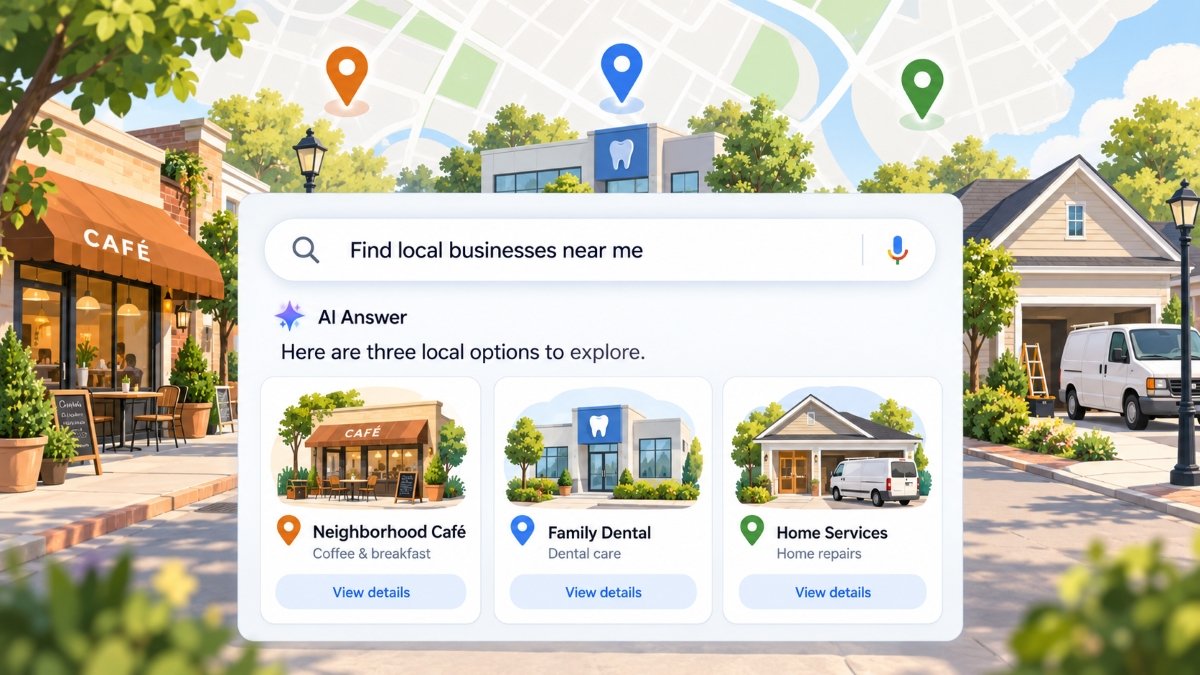
Abramyan cautions against treating those mentions as a prize to be won.
“Showing up in an AI summary isn’t a fixed position, and nobody can honestly guarantee it. Those mentions come and go as the systems update, and they change based on the searcher,” he says. “The durable goal is to be a business that every source describes the same way, so whenever the summary gets written, the facts point back to you.”
Credibility Is Built in Places a Business Doesn’t Fully Control
Customers and AI systems assemble their picture of a business from many places at once: review sites, directory listings, local news mentions, and the business’s own website. According to Google’s own guidance for site owners, AI Overviews and AI Mode may run several related searches across different topics and data sources to build a single answer.
That makes consistency matter as much as online reviews and star ratings. A phone number that differs between two directories or outdated hours on one listing plant small doubts. To a person, they suggest a business that isn’t paying attention. To an automated system, they make the business harder to describe with confidence.
The website’s job has shifted too. Instead of introducing a business, it now often confirms what a customer already suspects after reading reviews and the summary, and it has to make the next step easy. That sequence is the reasoning behind the Authority Engine™, which Abramyan developed for Curious Fortune Media: visibility gets a business onto the shortlist, authority makes it credible once it is there, and conversion makes the next step easy, instead of treating rankings, reputation, and the website as separate projects.
What Local Business Owners Can Take From the Shift
The first step costs nothing. Owners can search for their own business the way a customer would on a phone, using the words a stranger might type, and honestly review the results. Some find missing or outdated details.
From there, the work is mostly accuracy. Business details and descriptions should match everywhere they appear. Reviews work better as an ongoing habit than a one-time push, since customers weigh how recent they are and how owners respond. And progress is better measured by inquiries and booked appointments than by website visits alone, because a customer who decides on the results page may never register as traffic.
The woman with the toothache still made a choice. She simply made it earlier, and somewhere, the practice down the street couldn’t see it. Local businesses are now evaluated before they are contacted.
The tools will keep changing, and AI search is still evolving in ways no one can predict with certainty. The test underneath is older than any of it: whether a business looks consistent and easy to verify to someone who has never met it. For most owners, the useful question isn’t how search engines work. It’s what a stranger would conclude about their business in the first sixty seconds.