



AI pilots rarely fail at the model layer first. They fail in the basement: accounts no one owns, data paths no one traced, IAM exceptions copied from an old sprint, and logs that explain the damage only after the invoice arrives.
That is the uncomfortable gap behind many enterprise AI programs in 2026. The cloud estate may look mature on a dashboard. It may have landing zones, shared services, cost reports, and security tickets moving through Jira. Then teams start running retrieval pipelines, agent workflows, model evaluation jobs, and automated provisioning. The old AWS cloud foundation begins to show strain.
A modern AWS cloud foundation is no longer just a launchpad for applications; AWS cloud consulting services help enterprises redesign it for AI, automation, governance, and financial control. It is the operating boundary for AI, automation, identity, policy, data movement, and financial control. If that boundary is weak, the AI roadmap inherits the weakness.
Why Do Older AWS Foundations Struggle With AI?
Many AWS environments were built for migration. The goal was practical: move workloads, separate environments, centralize logs, connect networks, and keep production stable. That made sense when the main question was, “Can this application run safely on AWS?”
AI asks a sharper question: “Can this environment support rapid experimentation without losing control of data, cost, identity, model behavior, and audit evidence?”
Those are different questions. They need different foundations.
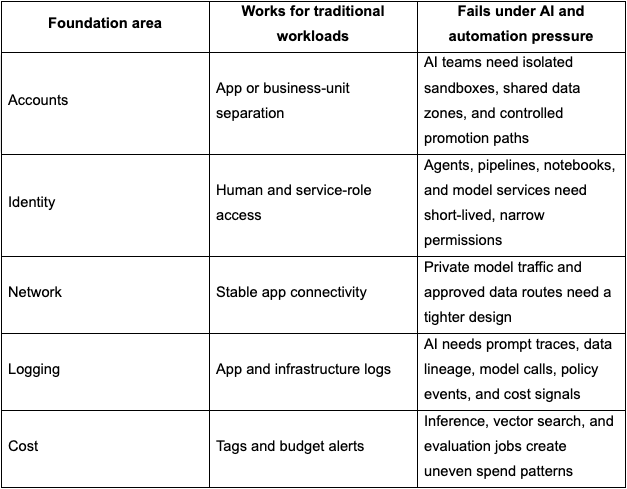
The issue is rarely one missing AWS service. It is the absence of a foundation model that treats AI and automation as first-class operating conditions. A board may approve an AI roadmap. A cloud team may approve a landing zone. A security team may approve a control set. Trouble starts when those approvals live in separate documents, and no one turns them into deployable guardrails.
What AI Workloads Demand From The Foundation?
AI workloads behave differently from ERP systems, portals, data warehouses, and mobile backends. They are more data-hungry, more experimental, and more dependent on chained services. They also create new evidence needs. The business must know what data was used, which model responded, what action followed, and who approved the production release.
An AWS foundation for AI workloads should treat these demands as design inputs:
- Fast sandbox creation with bounded permissions
- Private access to approved model services and data stores
- Standard patterns for retrieval, vector storage, monitoring, and model evaluation
- Cost controls that identify experiments, owners, and usage patterns
- Policy checks before workloads move from lab to production
- Audit evidence collected without a manual chase
The AWS foundation for AI workloads also has to support repeatable release paths. This is where cloud foundations for automation become important. Automation cannot be scripts wrapped around a shaky setup. It needs account vending, policy enforcement, network baselines, logging, backup, tagging, and incident hooks built into the environment.
The same applies to automation-ready cloud infrastructure. Teams need paved paths for provisioning, deployment, and rollback. Without them, engineers create local shortcuts. Those shortcuts become undocumented architecture.
A serious AWS cloud foundation gives teams a smaller menu of approved choices. That may sound restrictive. In practice, it reduces rework because teams spend less time asking for exceptions and more time building within patterns that security, platform, and finance already understand.
Why Do We Enterprises Need A Stricter AWS Strategy?
For large US organizations, AI has made cloud planning more political inside the enterprise. Legal, risk, procurement, security, data, and engineering teams now have direct opinions about architecture. That is useful, but it slows work when the foundation lacks clear ownership.
A mature US enterprise AWS strategy has to answer questions that older cloud programs often postponed:
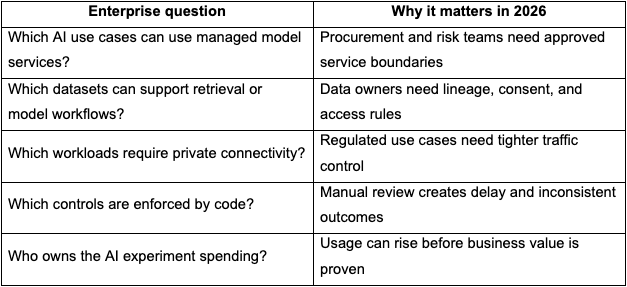
McKinsey’s 2025 State of AI research reported that nearly nine in ten respondents said their organizations regularly use AI, while many still struggle to embed it deeply into workflows. That gap shows up clearly in cloud programs. Adoption is ahead of architecture.
This is why a US enterprise AWS strategy cannot treat AI as scattered pilots. It needs a foundation view: approved services, permitted data paths, automated controls, accountable owners, and evidence collected by default.
Governance Has To Sit Inside The Build Path
Cloud governance used to mean policies, approvals, reports, and escalation paths. For AI, that cadence is too slow. Governance has to sit closer to the workload.
Cloud governance for AI should cover four practical layers.
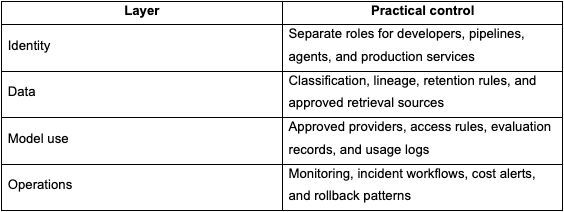
NIST’s AI Risk Management Framework and Generative AI Profile push organizations toward mapping, measuring, managing, and governing AI risk. The lesson for AWS teams is direct: risk language has to become engineering behavior.
Cloud governance for AI should appear as policy-as-code, service control policies, network rules, approval gates, tagging standards, logging baselines, and evidence stores. People still make judgment calls. The platform should remove the obvious bad paths before judgment is needed.
Data Design Is The Hidden Architecture Decision
Most AI strategy conversations spend too much time on models. The harder question is data movement. Where does the data come from? Who classified it? Can it be used for retrieval? Can prompts include it? Can outputs be stored? How long should traces remain available?
An AI-ready AWS architecture needs clean answers before production begins.
A practical pattern is to separate the environment into zones:
- Source zone for approved enterprise systems
- Processing zone for cleansing, masking, and enrichment
- Experiment zone for controlled AI development
- Evaluation zone for model quality and risk testing
- Production zone for approved AI services
- Evidence zone for logs, lineage, approvals, and cost records
This structure prevents the common mess where notebooks, prototypes, production endpoints, and sensitive datasets live too close together. It also gives compliance teams a map they can audit.
An AI-ready AWS architecture also needs metadata discipline. Without metadata, access reviews become guesswork. Retrieval quality drops. Incident response slows. Cost attribution weakens. The foundation should make metadata capture part of the path, not a request someone remembers near launch.
Security Needs A Different Access Model
Traditional cloud access was built around users, apps, and services. AI adds agents, plugins, vector stores, orchestration layers, evaluation pipelines, and third-party model endpoints. The identity graph becomes more complex.
This is where many teams underestimate risk. An agent with broad access is not just another service role. It can combine permissions, retrieve context, call tools, and act through workflows. If the permission boundary is loose, the blast radius grows quietly.
The better pattern is narrow and boring:
- Use short-lived credentials wherever practical
- Separate human, pipeline, workload, and agent identities
- Restrict access by environment, dataset, and action type
- Keep sensitive data away from general experiment spaces
- Require approval before new model services or data paths reach production
- Log tool calls, data access, prompts, responses, and policy decisions
Security teams do not need to slow the AI roadmap. They need the foundation to make safe paths easier than unsafe ones.
How To Rebuild The AWS Foundation For AI And Automation?
Rebuilding does not mean starting over. It means taking the current AWS cloud foundation and testing it against AI and automation use cases.
Start with use cases that matter to the business. A claims assistant, a finance reconciliation agent, a code review assistant, and a customer support summarizer do not carry the same data risk. They should not share the same path to production.
A sharper rebuild plan looks like this:
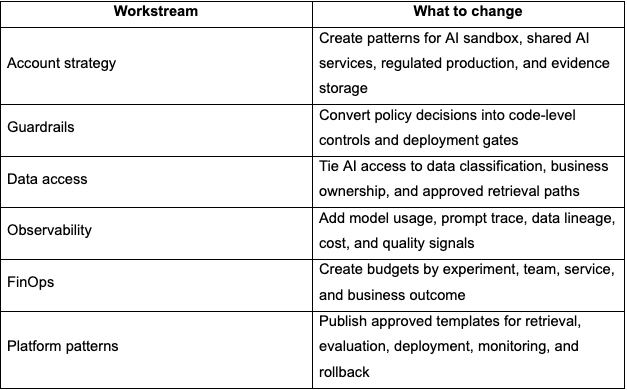
Cloud foundations for automation should be rebuilt around repeatable pathways, not one-off approvals. Account creation, IAM baselines, network routing, logging, tagging, backup, and incident hooks should arrive together. That is what makes automation-ready cloud infrastructure dependable under enterprise pressure.
A redesigned AWS cloud foundation should make three things clear to every team: what is allowed, how to build it, and how evidence is collected. If engineers need five meetings to answer those questions, the foundation is not ready.
Where Will Serious AWS Teams Focus Next?
The next phase of cloud maturity will be less about service adoption and more about operating discipline. The teams that move well will do a few unglamorous things consistently.
They will reduce choice in the right places. They will publish approved patterns instead of asking each team to invent its own. They will keep data classification close to deployment. They will treat AI cost as an architecture concern. They will bring security evidence into the build path. They will test automation pathways as seriously as application code.
That is the real work behind a modern AWS cloud foundation. The AWS cloud foundation becomes the control plane for responsible AI delivery.
AI does not forgive weak foundations. Automation exposes them faster. Enterprises that want dependable AI outcomes on AWS need to rebuild the ground layer first: accounts, identity, data, governance, security, observability, and cost control.
The quiet advantage belongs to organizations that stop treating the foundation as old plumbing. In 2026, the foundation is the product. The AI roadmap depends on it.