

By: Lauren Mitchell
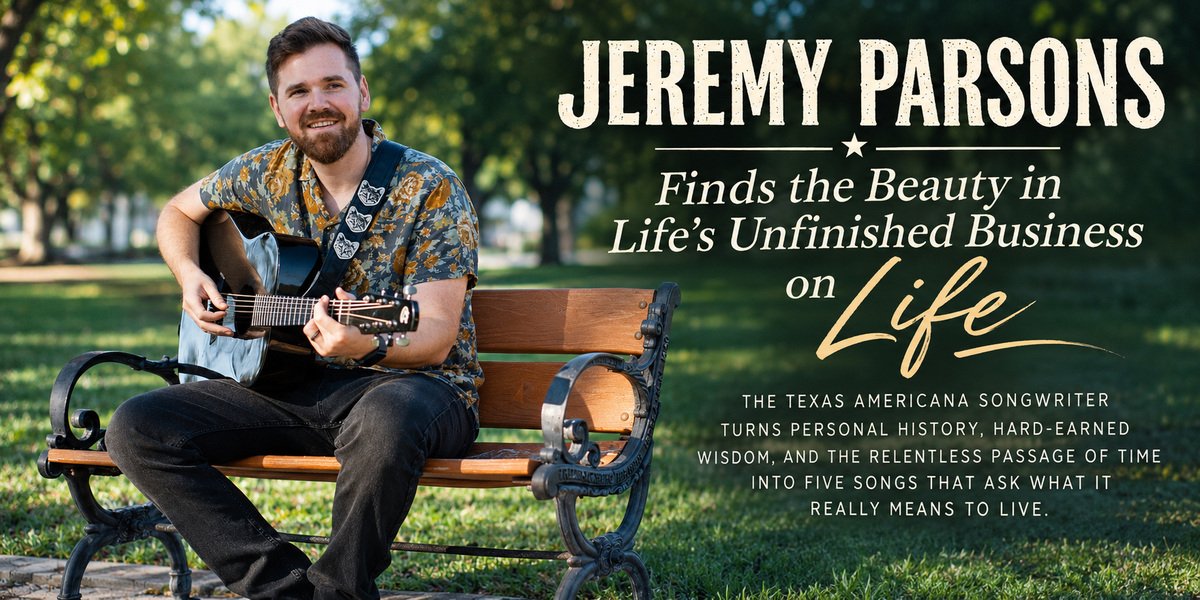
The Texas Americana songwriter turns personal history, hard-earned wisdom, and the relentless passage of time into five songs that ask what it really means to live.
There’s a particular kind of freedom that comes with realizing you no longer need to prove you have everything figured out. For some people, that realization arrives quietly, somewhere between the responsibilities of adulthood and the recognition that youth is officially in the rearview mirror. For Jeremy Parsons, it arrives in the form of Life, a five-song Americana EP that finds the San Antonio singer-songwriter taking inventory of his existence without pretending to have solved its mysteries.
The project is simultaneously intimate and expansive, concerned with the smallest details of personal experience and the biggest questions confronting humanity. Time, identity, empathy, regret, purpose, and mortality all receive consideration, but Parsons approaches them with the conversational ease of someone who has spent enough years on the road to understand that wisdom rarely announces itself with a dramatic entrance.
Instead, it accumulates. One decision, one mistake, one relationship, and one passing year at a time.
That philosophy establishes itself immediately on “Tickin’,” the EP’s opening meditation on time. The song’s central metaphor is hardly revolutionary; clocks have been reminding songwriters of their mortality for generations, but Parsons finds something compelling in the idea that even our seemingly wasted years possess value.
His insistence that time isn’t wasted when we choose to learn from it reframes the familiar anxiety surrounding aging. Rather than treating the clock as an adversary, Parsons suggests that the real tragedy would be failing to appreciate the experiences accumulating beneath its hands.
It’s an appealing perspective from an artist whose career has involved Nashville ambitions, unexpected detours, and the demanding realities of building an independent audience.
“The Garden” introduces a more delicate emotional vocabulary. Inspired by Parsons’ relationship with his horticulturist father, the song transforms the ordinary act of tending plants into a metaphor for personal well-being.
The question of what’s growing in another person’s garden becomes a way of asking how they’re doing beneath the surface. Are they flourishing? Are they struggling? Have they neglected the things that might help them grow?
There’s a quiet sophistication to the metaphor. Parsons understands that emotional health, like gardening, requires patience and attention. Growth cannot be forced, and even the most carefully cultivated life experiences difficult seasons.
The song’s imagery also establishes a thematic connection to the EP’s later exploration of humanity and the consequences of what people choose to nurture.
But Life reaches its emotional center with “Who Was I,” arguably the collection’s most revealing composition.
Parsons revisits himself at 25, remembering a younger man whose lifestyle revolved around getting high, sleeping through daylight, and chasing the possibility of becoming a professional musician. His parents had already embraced the conventional milestones of adulthood, while Parsons was pursuing something considerably less predictable.
The dream eventually took him to Nashville. It also brought disappointment, uncertainty, and a return to his father’s home at 32.
These details might have become material for a self-congratulatory redemption anthem. Parsons wisely chooses another direction.
Rather than condemning his younger self, he examines him with a mixture of curiosity, affection, and disbelief. The song’s central question, whether he’s chasing the dream or the dream is chasing him, captures something essential about artistic ambition.
When a pursuit becomes inseparable from your identity, where does personal choice end and obligation begin?
That question resonates beyond music. Anyone who has spent years building a career, maintaining a relationship, or pursuing a particular vision of success can recognize the complicated emotional territory Parsons is exploring.
His perspective carries additional significance in light of his recent celebration of ten years without alcohol. Sobriety has become an important chapter in his personal evolution, and although Life isn’t explicitly a sobriety record, its reflections on accountability, self-acceptance, and transformation feel particularly meaningful in that context.
On “Humanity,” Parsons expands his attention from individual experience to collective behavior.
The song considers judgment, social division, and the increasingly common tendency to mistake certainty for understanding. Rather than positioning himself above the conflicts he observes, Parsons acknowledges the limitations of his own perspective.
It’s a refreshing approach in an era when public conversation often rewards outrage more readily than reflection.
The gardening imagery returns through the idea that the seeds people plant, whether compassion or resentment, eventually determine the emotional landscapes they inhabit.
Parsons isn’t delivering a political manifesto. He’s asking listeners to consider the consequences of their everyday interactions.
That modest ambition gives the song its strength.
The EP concludes with “Life Worth Dyin’ For,” a title that initially sounds like it might introduce a grand philosophical declaration. Instead, Parsons offers something considerably more accessible.
He imagines reaching the end of his life and finding peace in the knowledge that he loved, laughed, stumbled, recovered, and participated fully in the experience of being alive.
There’s no suggestion that a meaningful existence requires celebrity, extraordinary wealth, or universal recognition.
The accomplishment is simply having lived with enough intention to accept the ending.
What makes Life compelling is how carefully these five songs complement one another. “Tickin’” establishes the urgency of passing time. “The Garden” considers the importance of cultivation. “Who Was I” confronts personal history. “Humanity” expands the conversation toward others. “Life Worth Dyin’ For” finally asks whether the accumulated experience has been worthwhile.
The result feels less like a conventional collection of singles than a compact emotional narrative.
Musically, Parsons operates comfortably within the Texas singer-songwriter tradition, drawing on country warmth, Americana textures, and a storytelling sensibility that prioritizes substance over spectacle. His approach doesn’t demand attention through exaggerated production or manufactured drama. The songs are designed to reveal themselves through their words and emotional continuity.
At a moment when popular music frequently celebrates reinvention as an opportunity to discard the past, Parsons offers a different proposition: perhaps personal growth is about learning to accept every version of yourself.
The restless dreamer. The uncertain adult. The man who made mistakes. The songwriter who kept going.
All of them belong to the same story.
And on Life, Jeremy Parsons makes a persuasive case that the story is worth celebrating precisely because it remains unfinished.
The clock keeps ticking. Parsons, thankfully, is still listening.