

For much of modern skincare, the skin barrier was described in architectural terms: a protective surface whose integrity depended on lipids arranged with unusual precision. Ceramides became central to that account because they help organize the stratum corneum and regulate permeability. Contemporary skin-barrier science now complicates that picture. The epidermis is a biochemical environment in which lipids, receptors, enzymes, and cellular signals participate in barrier function.
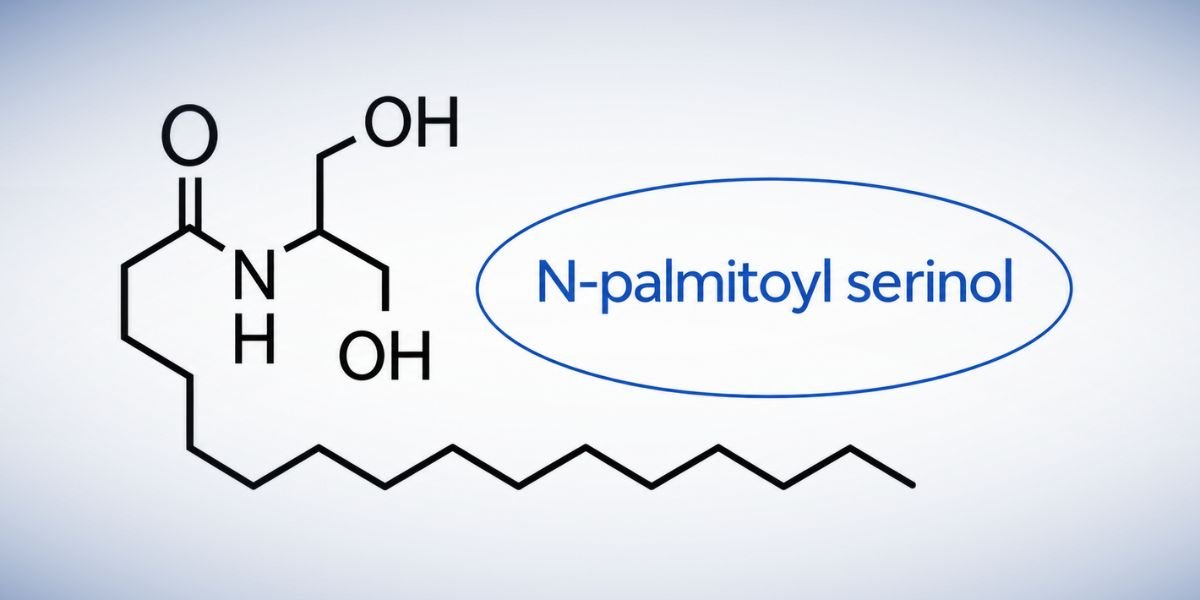
N-palmitoyl serinol, marketed as Neuromide®, belongs to this shift. Its significance lies in a question: how might a lipid-like molecule participate in the machinery governing ceramide production and epidermal function?
From Structure to Signaling
The path began with work on pseudoceramides and multilamellar lipid structures. Research associated with Raymond Park examined synthetic lipid systems designed to reproduce aspects of organization found in the stratum corneum. Such work treated formulation as a structural problem. If barrier lipids possess an ordered arrangement, can formulation science reproduce meaningful elements of it?
That earlier research established an intellectual foundation. The later focus on N-palmitoyl serinol shifted attention from lipid architecture toward lipid signaling. N-palmitoyl serinol is an N-acyl serinol structurally related to sphingolipid chemistry. Research has examined the compound as a ceramide mimic and investigated its relationship with ceramide metabolism and signaling pathways. [3]
The progression shifted the question from which lipids are present to what they do, how they communicate with cells, and how those interactions relate to epidermal function.
Endocannabinoid Connection
One important strand concerns the epidermal endocannabinoid system, a signaling network studied in skin biology. A 2019 paper examined N-palmitoyl serinol in the context of epidermal endocannabinoid signaling, while subsequent work brought the compound into closer conversation with ceramide biosynthesis. [1]
In a 2021 in vitro study using IL-4-treated keratinocytes, N-palmitoyl serinol increased total and very-long-chain ceramides. Researchers also examined CB1-dependent mechanisms and enzymes associated with ceramide synthesis, including CerS2 and CerS3. The findings offer experimental evidence linking N-palmitoyl serinol, CB1 signaling and ceramide production in cultured skin cells. They do not, on their own, establish a clinical effect in humans. [2]
That distinction matters. Laboratory observations should not be given more weight than their evidence permits. The more consequential story is the mechanism under investigation: a lipid-related compound interacting with a receptor pathway that may influence the epidermal lipid environment.
From Molecule to Formulation
Dr. Raymond Lab describes its work as an integration of biological mechanisms, lipid chemistry, formulation structure, and measurable barrier performance. The progression extends from pseudoceramides and multilamellar emulsions to N-palmitoyl serinol, then to advanced lamellar technologies such as Crystal Lamella MES®, clinical evaluation, and consumer applications under Curecode®.
This sequence reflects a broader change in cosmetic science. Ingredient research and formulation research can no longer be treated as separate worlds. A molecule’s biological activity matters, but so does the environment in which it is delivered and the structural organization that surrounds it.
The larger cultural shift is from skincare as surface management to applied biology. Consumers may encounter creams and barrier products as finished objects on a bathroom shelf. Behind them lies a harder question: how can the skin’s lipid economy be understood well enough to design formulations that respect its biology?
More Careful Kind of Innovation
N-palmitoyl serinol sits within that evolving inquiry. Its research history includes ceramide biology, CB1 signaling, microbiome-associated lipid research, and experimental neurobiological studies. Those areas remain scientific research rather than grounds for therapeutic claims, especially in exploratory skin–brain work.
What makes this trajectory culturally interesting is its patience and restraint. The story is not simply about another ingredient. It is about a field gradually changing its vocabulary, from barrier repair toward lipid organization, receptor signaling, cellular regulation, and measurable function.
Takeaway
The future of skincare may belong less to loud ingredient claims than to integration across disciplines. In that landscape, N-palmitoyl serinol represents one chapter in a continuing effort to understand the skin not as an inert boundary, but as living tissue whose chemistry, structure, and signals are inseparable.
Selected Scientific References
[1] Jeong, S., Kim, M. S., Lee, S. H., & Park, B. D. (2019). “Epidermal Endocannabinoid System (EES) and its Cosmetic Application.” Cosmetics, 6(2), 33. https://doi.org/10.3390/cosmetics6020033
[2] Shin, K. O., Kim, S., Park, B. D., Uchida, Y., & Park, K. (2021). “N-Palmitoyl Serinol Stimulates Ceramide Production through a CB1-Dependent Mechanism in In Vitro Model of Skin Inflammation.” International Journal of Molecular Sciences, 22(15), 8302. https://doi.org/10.3390/ijms22158302
[3] Bieberich, E., Kawaguchi, T., & Yu, R. K. (2000). “N-acylated serinol is a novel ceramide mimic inducing apoptosis in neuroblastoma cells.” Journal of Biological Chemistry, 275(1), 177–181. https://doi.org/10.1074/jbc.275.1.177
Disclaimer: This article is for informational and educational purposes only and does not constitute medical advice. The scientific findings discussed include laboratory and preclinical research and should not be interpreted as evidence of established clinical efficacy or therapeutic benefits in humans. The products and ingredients mentioned are not intended to diagnose, treat, cure, or prevent any disease. Consult a qualified healthcare professional regarding specific skin conditions or medical concerns.