


Equipment financing is a way of paying for business equipment over time, with the equipment itself usually serving as security for the obligation. It covers everything from a used box truck to an MRI machine. Approval within 24 hours is often achievable for routine transactions, while complex or high-value deals take longer.
The best way to understand it is to work through a real decision. This article is set up as a worksheet: each numbered line explains one element of equipment financing and asks you to fill in your own number. By the final line, you’ll have a clear view of whether a deal makes sense.
Line 1: Equipment Price
Write down the full cost before financing: $________
Include the sale price, freight, installation, and sales tax where applicable. Many programs can finance some of these “soft costs,” within limits. Knowing the full price at the outset prevents an unwelcome surprise at signing.
Sample figure throughout this worksheet: a commercial bakery oven priced at $62,000 installed.
Line 2: Down Payment
Write down the cash you’d put in: $________
Strong borrowers may be approved for 100% financing, while others are asked for 10% to 20% or more. A larger down payment reduces your payment and improves your odds if your credit is weaker, but it also uses up cash you may need elsewhere.
Sample: $6,200, which is 10%.
Line 3: Amount Financed
Subtract Line 2 from Line 1: $________
Sample: $55,800.
Before moving on, it helps to see how this product compares with broader funding options. An overview of Fundivi equipment loan programs shows one way these terms are presented, and you can use it as a checklist for what to ask other providers.
Line 4: Structure
Check one:
☐ Equipment loan: you own it from the start
☐ $1 buyout lease: you effectively own it at the end
☐ Fair market value lease: you may return it, renew, or buy it at market price
☐ Sale-leaseback: you sell equipment you already own and lease it back
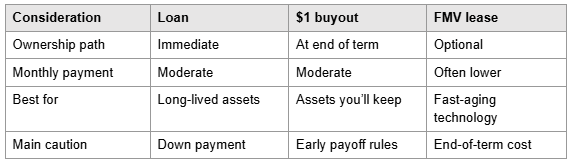
Sample: the bakery chooses a loan, since a good oven should last well beyond the financing term.
Line 5: Term in Months
Write down the term offered: ________ months
Lenders tie the term to the equipment’s useful life. A rule worth following is that the financing shouldn’t outlast the asset. If a machine has a realistic life of five years, a seven-year contract means you’ll be paying for equipment you’ve already replaced.
Sample: 60 months.
Line 6: Monthly Payment
Write down the quoted payment: $________
Sample: $1,165.
Now confirm that your cash flow can support it. Look at your slowest three months from last year and subtract the payment. If you don’t have enough left over, go back to Line 2 or Line 5. Some industries can request seasonal or step-up payment schedules, so it’s worth asking whether one is available.
Bear in mind that a low monthly figure may rest on an unusually long term or a large balloon payment at the end. A guide to working capital loan alternatives to asset-backed debt can help you judge whether equipment financing is truly the right product compared with general unsecured funding.
Line 7: Total of Payments
Multiply Line 5 by Line 6: $________
Sample: 60 × $1,165 = $69,900.
Line 8: Fees and End-of-Term Cost
Write down documentation fees, origination fees, and any purchase amount owed at the end: $________
Sample: $495 documentation fee.
Line 9: Total Cost of Financing
Add Lines 7 and 8, then subtract Line 3: $________
Sample: $69,900 + $495 − $55,800 = $14,595.
That’s the true price of paying over time. Compare it across offers, keeping your terms consistent.
Line 10: Monthly Benefit
Write down what the equipment will earn or save per month after direct costs: $________
Sample: the new oven adds $5,500 in monthly sales at a 45% gross margin, or $2,475, and reduces energy costs by about $225. Total: $2,700.
Be conservative. Then run a second calculation with half that benefit. In the sample, half of $2,700 is $1,350, which still covers the $1,165 payment. That’s a good sign.
Line 11: Tax Effect
Ask your tax professional, then jot down an estimate: $________
Section 179 expensing and bonus depreciation can reduce your taxable income, but limits and eligibility vary, and rules can change. Lease payments may be handled differently than loan interest and depreciation. A deduction reduces cost, but doesn’t eliminate it, so a purchase that doesn’t make economic sense before tax rarely makes sense because of a tax break.
Line 12: Approval Readiness
Check all that apply. The more boxes you tick, the more plausible 24-hour approval becomes.
☐ I have a written quote with make, model, and seller details
☐ I have three months of complete business bank statements
☐ I have identification for each significant owner
☐ My business registration is current
☐ The seller is an established dealer
☐ The equipment has a known resale market
☐ The amount is within an application-only program, if one is offered
☐ I can apply early on a business day
Approval and funding differ here. A lender can approve your credit in a day, but pays the vendor only after signed documents and, often, delivery confirmation. Custom-built machinery, private-party sales, and much older equipment usually require added review. Never sign a delivery and acceptance statement until the equipment has arrived and works as promised.
Line 13: Source Check
List three financing sources, and note who funds each deal:
• Equipment manufacturer or dealer finance program
• Your bank or credit union
• An independent or online finance company
Dealer promotions, such as low-rate programs on new machines, can be hard to beat, though they may require paying list price with no cash discount. Sites such as the BestMCALoans.com alternative funding notes can offer perspective on what happens when owners rely on expensive advances rather than asset-based financing for machinery.
Line 14: Final Decision
Compare Line 10 with Line 6:
• Benefit is more than double the payment: Strong candidate.
• Benefit is 1 to 2 times the payment: Workable, but test the downside.
• Benefit is less than the payment: Reconsider, unless the purchase protects existing revenue, such as replacing the only oven you have.
Sample: $2,700 ÷ $1,165 is about 2.3 times. The bakery proceeds.
Before signing, read the contract for blanket liens, insurance requirements, automatic lease renewals, and any clause requiring payment regardless of the equipment’s performance. If your equipment supports a card-based business, you may also want to examine this Macau Business article on Fundivi’s credit card processing loans, since some merchants prefer repayment tied to daily sales.
Frequently Asked Questions
Can I finance used equipment?
Yes, often, though lenders may limit its age, require an inspection, or offer shorter terms than for new equipment.
Who owns the equipment during financing?
With a loan, you generally hold title while the lender has a lien. With many leases, the lessor owns it until a purchase occurs.
Does equipment financing require good credit?
Stronger credit improves your terms, but the collateral can help applicants with lower scores, often with a larger down payment.
What if the equipment breaks?
Your payment obligation usually continues. Look to the warranty, service agreement, and insurance for help.
Can I pay off early?
Some loans permit it with savings. Many leases require most or all remaining payments, so confirm the terms first.
Is software eligible?
Sometimes, when bundled with hardware or offered through specialized programs. Standalone software is harder to finance because its resale value is limited.
How quickly does the vendor get paid?
Often within a day or two after signed documents and delivery confirmation are complete. Ask the lender what it needs from the vendor so nothing is left to the last minute.
Will I need to provide insurance?
Typically yes. Lenders commonly require proof of coverage and want to be named as loss payee, so contact your insurance agent early.
Can one contract cover several machines?
Often, through a master agreement or schedule. That can simplify paperwork when you expect to buy in stages.
Does the lender inspect the equipment?
Sometimes, mainly for used or high-value assets.
Disclaimer: This article is provided for general informational and educational purposes only and does not constitute financial, legal, tax, accounting, or lending advice. Equipment financing terms, rates, fees, eligibility requirements, approval criteria, ownership structures, tax treatment, and funding timelines vary by lender, equipment, transaction, business, and jurisdiction. References to specific lenders, platforms, products, or financing options do not constitute an endorsement or guarantee of approval, funding speed, suitability, or terms. Business owners should review all financing and lease agreements carefully and consult qualified financial, legal, tax, or accounting professionals regarding their individual circumstances before making financing decisions.