


By: Natalie Johnson
Artificial intelligence (AI) dominates conversations about the future of business, but the organizations seeing the greatest returns are the ones applying technology with a clear business purpose. According to Christophe Derdeyn, Managing Director of Icon Consulting Group, the next wave of IT innovation will be defined by how effectively businesses combine technology with organizational change.
“We’re really in the forefront of using AI, or what I call applied AI,” says Derdeyn. “You can do so much more with less and actually increase quality while you do it at the same time.” That philosophy has shaped a career spanning everything from Y2K infrastructure projects to leading enterprise resource planning (ERP) modernization initiatives, building a regional systems integrator across Southeast Asia, and helping organizations rethink how technology supports growth. Below, he shares how organizations can use technology to create value by ensuring it enables people to focus on the work that matters most.
Technology That Serves Business, Not the Other Way Around
“What you do when you use AI is you make an IT environment or the applications that people use much more fit for purpose,” he says. “You make it much easier to access specific information, data, and insights, and because of this you can actually repurpose the focus of people on where it matters most.”
Rather than replacing employees, applied AI removes low-value administrative work, giving sales teams, product developers, and decision-makers faster access to information that helps them respond to customers and markets more effectively. This is how IT innovation drives business growth. Productivity gains become meaningful only when organizations redirect the time they save toward higher-value activities that strengthen competitive advantage.
While AI dominates headlines, most companies remain in the earliest stages of adoption. Many are still using generative AI primarily for drafting content or conducting basic research, while more advanced organizations are embedding intelligent agents directly into business operations.
Why ERP Modernization Demands Operating-Model Change
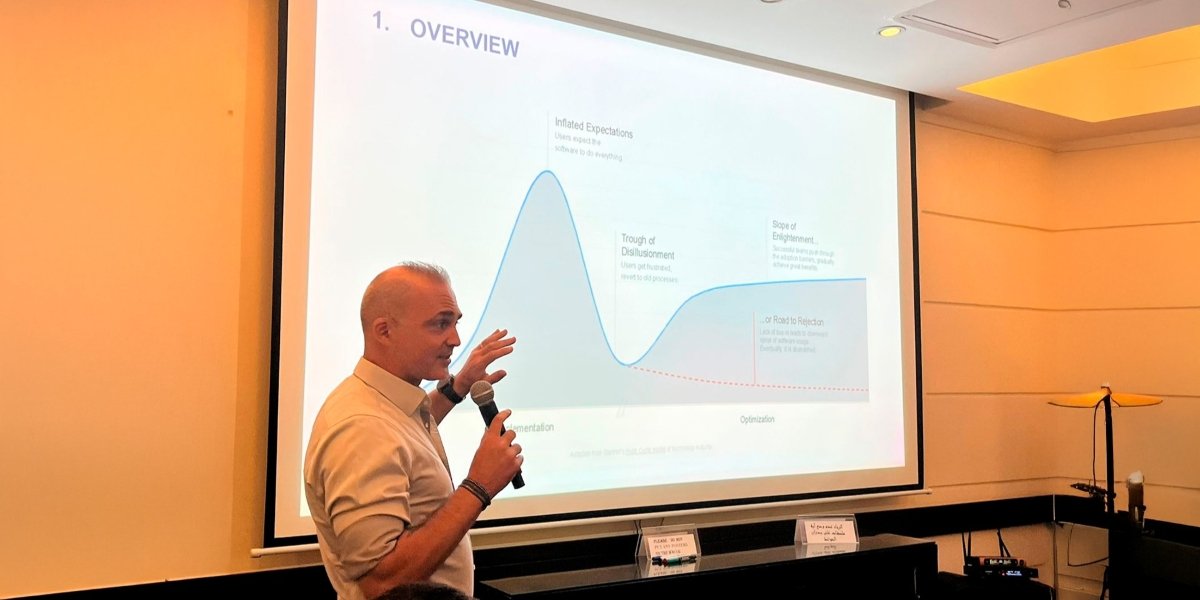
Technology transformation success doesn’t come down to software alone. Whether organizations are pursuing ERP transformation in Southeast Asia or modernizing legacy infrastructure elsewhere, success depends on understanding how people work before introducing new systems. “When you modernize a company’s systems, it starts first with taking stock of what they have,” Derdeyn says. “It’s not either technology or the way people work. You need to change both at the same time because only then do you have a much higher likelihood of reaching a successful outcome.”
This perspective reflects years spent leading business transformation initiatives for global enterprises. Organizations often accumulate layers of disconnected applications, each solving an individual problem but creating increasing operational complexity over time. Simply replacing those systems without redesigning workflows often recreates the same inefficiencies on newer technology. That is why operating-model change and technology modernization must move together. Processes, governance, and employee responsibilities all need to evolve alongside enterprise systems if transformation is to deliver lasting value.
Building Smarter Organizations with Human Accountability
As AI agents become increasingly capable of making operational decisions, organizations are beginning to rethink the structure of their back offices and shared services functions. Yet Derdeyn is clear that greater automation should never remove human responsibility.
“AI can never be held accountable,” he says. “It’s always the people who put AI in place or the companies that run AI that will be accountable.” Instead of replacing leadership, intelligent systems should augment it. Routine decisions can be automated, provided every action remains traceable and auditable. This balance creates opportunities for organizations to rethink resource allocation. As repetitive work becomes automated, businesses can invest more heavily in customer relationships, innovation, and market expansion.
Automating routine back-office processing also changes how leadership teams allocate attention. Shared services functions that once spent most of their capacity on transaction handling can take on analysis, supplier relationships, and process design instead. For organizations pursuing enterprise solutions, offshore services, or large-scale shared services transformations, the greatest opportunity lies not in reducing headcount but in enabling skilled professionals to spend more time creating value.
Scaling Growth Through Applied AI
Having spent decades scaling ventures, building a systems integrator, and helping enterprises modernize their operations, Derdeyn sees AI as the next evolution of business transformation rather than a standalone technology trend. “We should start talking about applied AI rather than just AI,” he says. “We have senior people with a lot of experience who get enabled to use AI in their daily work. They’re the human in control. They’re the senior decision-maker, but they have AI enablement.”
As businesses continue investing in cloud solutions, enterprise solutions, and modernization initiatives, the organizations that create lasting competitive advantage will be those that view technology as an enabler of better decisions, stronger operating models, and sustainable growth. The future of transformation belongs to those that apply it with purpose.
For more insights, follow Christophe Derdeyn on LinkedIn or visit his website.