

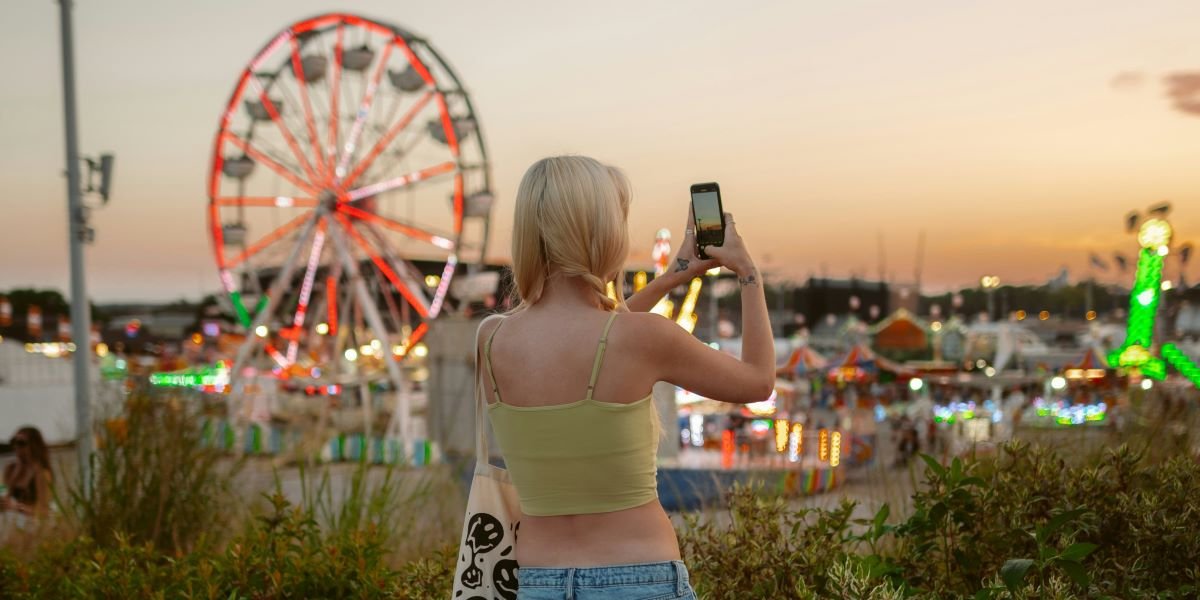
A 110-foot Ferris wheel now stands between the Smithsonian Castle and the Washington Monument. Neoclassical white tents stretch across ten city blocks. Rodeo riders warm up in temporary arenas, and the smell of jumbo corn dogs drifts past the National Gallery of Art. The Great American State Fair — a 16-day, free national exposition marking the 250th anniversary of the United States — opened to the public on June 25 on the National Mall, and the scale of the undertaking is unlike anything the capital has hosted in modern memory.
What Visitors Will Find on the Ground
The fair occupies the National Mall between 4th Street and 14th Street, spanning the corridor from the U.S. Capitol toward the Washington Monument. More than 150 exhibits from all 56 U.S. states and territories are housed inside beaux-arts-style pavilion tents, each designed to showcase a state’s culture, industry, landscape, and history through interactive experiences rather than static displays.
The state-level creativity is where the fair finds its texture. Arizona’s pavilion takes visitors through a sensory sequence — cathedral light mimicking Antelope Canyon, dappled shade evoking a Ponderosa pine forest, and a blacklit Sonoran Desert nightscape with illuminated saguaro cacti. Montana offers a hands-on fossil-digging station. Minnesota fills a pool with miniature versions of the common loon, the state bird, for a carnival-style prize game. Oklahoma’s designers replicated the smell of prairie grass and installed fans to evoke the lyrics of the Rogers and Hammerstein musical, with lighting that transitions from sunrise to evening. Florida’s pavilion moves visitors from the Everglades through the state’s agricultural heritage and culminates in a tribute to Cape Canaveral’s role in space exploration, from the Apollo missions through Artemis. Illinois contributed a holographic installation featuring stories from more than 50 residents, organized independently through the Peoria Riverfront Museum.
Beyond the pavilions, the fairgrounds include daily rodeo shows with precision-riding demonstrations and traditional Mexican charro performances, carnival rides, movie screenings, military band performances, and food vendors serving state fair staples — turkey legs, buckets of fries, and pancakes from Judy’s Family Cafe, an Illinois diner known for its viral social media presence.
A Daily Calendar Built Around National Themes
Each of the fair’s 16 days carries a distinct programming theme. Opening day, June 25, is branded “The American Canon,” focusing on architecture, infrastructure, and culture. Friday, June 26, turns to “Land and Prosperity,” highlighting agriculture, ranching, and land stewardship. Saturday is “The American Canvas,” centered on visual and performing arts. Subsequent days cycle through topics including faith and values, automotive and industrial heritage, military and veterans appreciation, education and opportunity, and family life. July 4th is designated as the Independence Day Celebration, with a fireworks display over the National Mall. The final day, July 10, is titled “The Next 250: Innovation,” focusing on AI, space propulsion, robotics, and energy independence.
The fair operates daily — Sunday through Wednesday from 10 a.m. to 9 p.m., Thursday through Saturday from 10 a.m. to 11 p.m., and until midnight on July 4th. Admission is free, with advance registration encouraged. Security checkpoints are positioned at every entrance, and visitors are limited to one small clear bag or clutch per person.
Logistics and the City Around the Fair
The event’s footprint has required significant coordination across federal and municipal agencies. The District of Columbia has budgeted approximately $90 million for security across all summer events on the Mall, which also include the 2026 FIFA World Cup Fan Zone running through July 19. The National Guard and federal law enforcement are collaborating on public safety operations for the duration.
The Metropolitan Washington Airports Authority has warned travelers at Reagan National Airport to expect periodic flight adjustments due to downtown flyovers and aerial displays scheduled throughout the 16 days, with the most significant disruptions expected on July 3 and 4. Multiple downtown streets surrounding the Mall have been closed since the buildout phase began and will remain restricted through at least July 11 to allow for demobilization.
The Broader 250th Anniversary Landscape
The Great American State Fair is one component of a broader national commemoration. A parallel organization, America250 — a nonpartisan commission created by Congress in 2015 — is coordinating celebrations at the local level across the country. Its centerpiece event is a July 4th concert in Los Angeles featuring Chris Stapleton, the Smashing Pumpkins, and Queen Latifah, with tickets priced at $17.76. The commission has also assembled a sealed time capsule containing contributions from every state, scheduled for public unveiling during the holiday weekend.
The fair itself is organized by Freedom 250, a nonprofit whose CEO Keith Krach described the event as an opportunity for visitors to “taste, touch, and experience what makes each state and territory unique.” The organization has faced logistical headwinds — several states initially declined to staff pavilions, citing costs that ranged from $100,000 to more than $500,000, and some musical artists who had been scheduled to perform withdrew ahead of opening day. Freedom 250 has said that all 56 states and territories are represented in the final exhibition regardless of individual state funding decisions, and that hundreds of performers remain on the entertainment schedule across the 16-day run.
What the Fair Represents
Whether visitors come for the Ferris wheel, the state pavilions, or the rodeo, the Great American State Fair is an attempt to do something that national commemorations have always struggled with: compress 250 years of a continental country’s identity into a physical space people can walk through in an afternoon. The pavilion designers appear to understand that the effort works when it gets specific — not when it tells visitors what America means, but when it lets them smell Oklahoma’s prairie grass, dig for Montana fossils, or stand inside a blacklit Arizona canyon and decide for themselves.
The fair runs through July 10. Visitors are encouraged to use Metro or rideshare, as no dedicated parking is available on the Mall.