


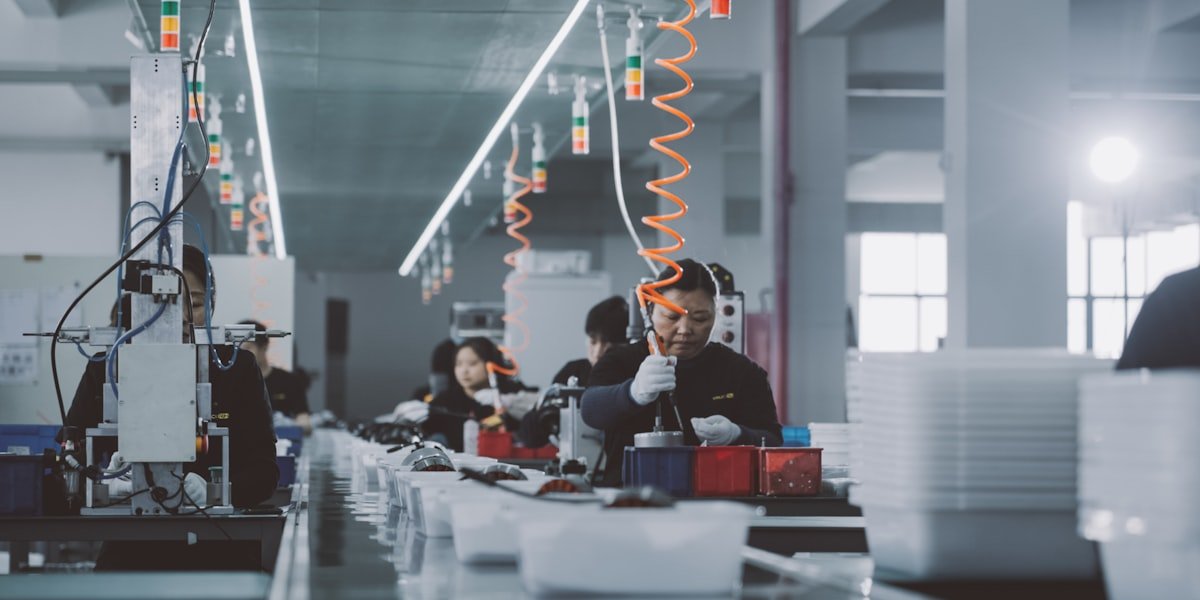
Labor shortages, supply chain gaps, and policy uncertainty block American manufacturers from relocating production despite tariffs and government incentives pushing them to reshore from China. Manufacturing reshoring barriers have stopped the wave of factory relocations cold, leaving many firms stuck in overseas supply chains they once hoped to abandon. Policy whiplash, skill shortages, and the sheer cost of building new domestic facilities mean that even companies committed to reshoring struggle to execute.
Key Takeaways
- The Kearney Reshoring Index fell into negative territory from 2023 to 2024, dropping over 300 basis points as companies struggled to execute relocation plans.
- Only 2 percent of chief executives and chief operating officers had fully completed their reshoring or near-shoring plans, despite 81 percent stating they intended to bring supply chains closer to home.
- A majority of respondents to a CNBC survey estimated that building a new domestic supply chain would cost around double or more than current costs.
- Labor availability and skill gaps in the United States rank as a top challenge for manufacturers attempting to reshore production from China.
The Kearney Reshoring Index fell into negative territory from 2023 to 2024, dropping over 300 basis points. A separate study found that while 81 percent of chief executives and chief operating officers plan to bring supply chains closer to home, only 2 percent had fully completed their reshoring or near-shoring plans. Investment banks and rating agencies forecast that investment and economic growth in the United States have not changed despite recent headline-grabbing pledges by the private sector.
Why Can’t Manufacturers Leave China?
China offers skill and scale no other country can match. Apple CEO Tim Cook said companies go to China because of the skill and the quantity of the skill in one location, adding that in the United States a meeting of tooling engineers might not fill a single room. The concentration of specialized labor, suppliers, and infrastructure creates a self-reinforcing ecosystem that is difficult to replicate elsewhere.
Skilled manufacturing labor remains scarce across the United States. A majority of respondents to a CNBC survey estimated that the price tag of building a new domestic supply chain would be around double or more than current costs. Facilities can take years to build and often cost multiples of average gross operating surplus, particularly in basic manufacturing industries.
Even when companies commit to reshoring, they face nagging gaps in their domestic supply chains. Research from the National Institute of Standards and Technology notes that addressing these gaps requires expanding capabilities, working with new partners, or integrating technology. Without a robust network of domestic suppliers, manufacturers cannot achieve the lead-time reductions and quality control that reshoring promises.
How Does Policy Uncertainty Stall Reshoring Decisions?
Frequent policy shifts poison long-term investment decisions. Companies feel uncertain about the incidence and size of import tariffs, high interest rates, other countries’ retaliatory acts against US trade protectionism, the livelihood of Inflation Reduction Act and CHIPS Act subsidies, and future procurement by US agencies. Rational boardrooms will not risk years of profit by breaking ground on new facilities if tariff rates shift again and render investment less competitive.
The Trump administration maintains a running list of reshoring commitments by businesses, yet some of those pledges are dubious. Investment banks and rating agencies find that investment and economic growth in the United States have not changed despite the announcements. Policy volatility discourages the multiyear capital commitments that new factories require.
US Reporter has documented how trade duties now dominate site-selection calculations, yet those same duties shift unpredictably. Companies that built reshoring plans around one tariff regime find their assumptions invalidated when a new administration or trade negotiation changes the rules. The result is paralysis at the planning stage, with executives unwilling to commit capital until they see sustained policy stability.

What Structural Obstacles Block Domestic Production?
Labor availability and skill gaps in the United States are a top challenge, particularly in manufacturing. A study of Swedish manufacturing firms identified labor resources, facilities and equipment, labor costs, overhead costs, and total costs as prominent barriers to reshoring. The same research revealed that manufacturing capacity, labor resources, know-how and intellectual property, infrastructure, and automation level serve as key enablers when they are present.
Total cost, product quality, controllability, and flexibility in production drive reshoring decisions. Yet the absence of sufficient skilled workers and the expense of training new hires undercut those advantages. Companies that reshore often discover they must invest heavily in workforce development, adding years to the timeline before a domestic facility reaches full productivity.
Infrastructure gaps compound the labor problem. Domestic suppliers may lack the capacity to deliver components at the volume and price point that offshore suppliers provide. Building that capacity requires coordinated investment across entire industries, not just individual firms. Without government support or industry consortia to fill those gaps, manufacturers remain tethered to their existing offshore networks.
Are Reshoring Incentives Effective?
Government incentives have not yet translated into widespread reshoring success. The National Institute of Standards and Technology published a white paper in February 2025 on how US manufacturers can take advantage of reshoring, outlining strategies for finding domestic suppliers, filling supply chain gaps, and building value-driven relationships. The document emphasizes that smaller manufacturers can position themselves as key players in rebuilding domestic supply chains, but it also acknowledges that careful consideration of cost, supply chain reliability, and potential risks is required.
Federal infrastructure funding and tax credits aim to lower the cost barrier, yet execution lags. Companies must navigate complex application processes, meet stringent requirements, and wait months or years for funding approval. By the time incentives arrive, market conditions may have shifted again, rendering the original reshoring plan obsolete.
Near-shoring to Mexico or Canada offers a middle path, but it does not solve the structural challenges that make China attractive. Proximity reduces shipping time, yet it does not address skill shortages or supply chain depth. Firms that near-shore still rely on components manufactured in Asia, limiting the resilience gains they hoped to achieve.
Will Automation Solve the Labor Problem?
Automation can offset some labor constraints, but it introduces new costs and complexities. High levels of automation require upfront capital investment, ongoing maintenance, and skilled technicians to program and repair the equipment. For labor-intensive industries such as apparel or electronics assembly, the return on investment in automation may not justify the expense compared to low-wage offshore production.
The National Institute of Standards and Technology notes that integrating technology is one way to fill gaps in the supply chain. Automation enables manufacturers to reduce headcount per unit of output, but it does not eliminate the need for skilled workers. Instead, it shifts demand from assembly-line operators to robotics engineers and maintenance technicians, skill sets that are equally scarce in the United States.
Companies that successfully automate domestic facilities still face competition from offshore plants that combine lower wages with their own automation investments. China has rapidly adopted industrial robots and advanced manufacturing techniques, preserving its cost advantage even as labor wages rise. Automation alone does not erase the structural advantages that keep production overseas.
Can Small Manufacturers Capture Reshoring Opportunities?
Smaller manufacturers face both opportunities and obstacles in the reshoring wave. The National Institute of Standards and Technology advises that they can become suppliers of choice by improving customer service, investing in technology, and fostering value-driven partnerships. Reshoring companies increasingly look to build regional supply chains to shorten lead times and reduce risk, creating openings for nimble domestic suppliers.
Yet smaller firms often lack the capital to scale production quickly or invest in the advanced equipment that reshoring clients demand. They compete with established offshore suppliers that have decades of relationships, proven track records, and economies of scale. Without access to patient capital or government-backed loans, many small manufacturers cannot seize the reshoring opportunities that policymakers envision.
Building stronger relationships with nearby suppliers and customers can create long-lasting benefits. Aligning with companies that prioritize quality, transparency, and sustainability offers a competitive edge that offshore suppliers cannot easily replicate. Still, these intangible advantages must overcome the hard reality of price and delivery performance, where offshore incumbents retain a decisive lead.
FAQs
What Is the Biggest Obstacle to Reshoring Manufacturing From China?
Labor availability and skill gaps in the United States are the top challenge. Apple CEO Tim Cook noted that companies go to China because of the skill and quantity of skilled workers in one location, while the United States struggles to fill a room with tooling engineers. Building domestic facilities also requires multiples of average gross operating surplus and can take years.
How Much Does It Cost to Build a New Domestic Supply Chain?
A majority of respondents to a CNBC survey estimated that the price tag would be around double or more than current costs. Facilities can take years to build and often cost multiples of average gross operating surplus, particularly in basic manufacturing industries.
Why Do Policy Changes Hurt Reshoring Plans?
Frequent policy shifts create uncertainty about import tariffs, subsidies, and future procurement, discouraging multiyear capital commitments. Rational boardrooms will not risk years of profit by building new facilities if tariff rates or regulations shift again and render the investment less competitive.
Can Automation Replace Offshore Labor?
Automation can offset some labor constraints, but it introduces new costs and requires skilled technicians to program and repair equipment. China has rapidly adopted industrial robots and advanced manufacturing techniques, preserving its cost advantage even as wages rise. Automation alone does not erase the structural advantages that keep production overseas.
What Role Do Government Incentives Play in Reshoring?
Government incentives such as federal infrastructure funding and tax credits aim to lower cost barriers, but execution lags. Companies must navigate complex application processes and wait months or years for funding approval. By the time incentives arrive, market conditions may have shifted again, rendering the original reshoring plan obsolete.
Are Smaller Manufacturers Able to Compete for Reshoring Business?
Smaller manufacturers can become suppliers of choice by improving customer service and investing in technology, and reshoring companies increasingly look to build regional supply chains. Yet smaller firms often lack the capital to scale production quickly or invest in advanced equipment, and they compete with established offshore suppliers that have decades of relationships and economies of scale.