

Competitive athletics builds assets that most models never develop. For a German teenage champion, the training came first; everything else followed.
Modeling, at its technical core, is a discipline of the body. It demands spatial awareness, physical control, the ability to hold positions under fatigue, and the mental endurance to repeat movements until they meet an external standard. These are athletic requirements.
Yet the industry rarely recruits from athletic backgrounds, preferring instead to train presence from scratch, or hope it arrives naturally.
This gap explains why athletes who transition to modeling often possess advantages that take others years to develop. They arrive with bodies already conditioned for precision. They understand repetition as methodology rather than tedium. And they have competed under pressure that makes a casting call feel manageable by comparison.
Nelly Opitz is not yet a household name in either field. But she represents a case worth watching: a competitive athlete whose physical training preceded any commercial ambition, and whose approach to modeling reflects that sequence.
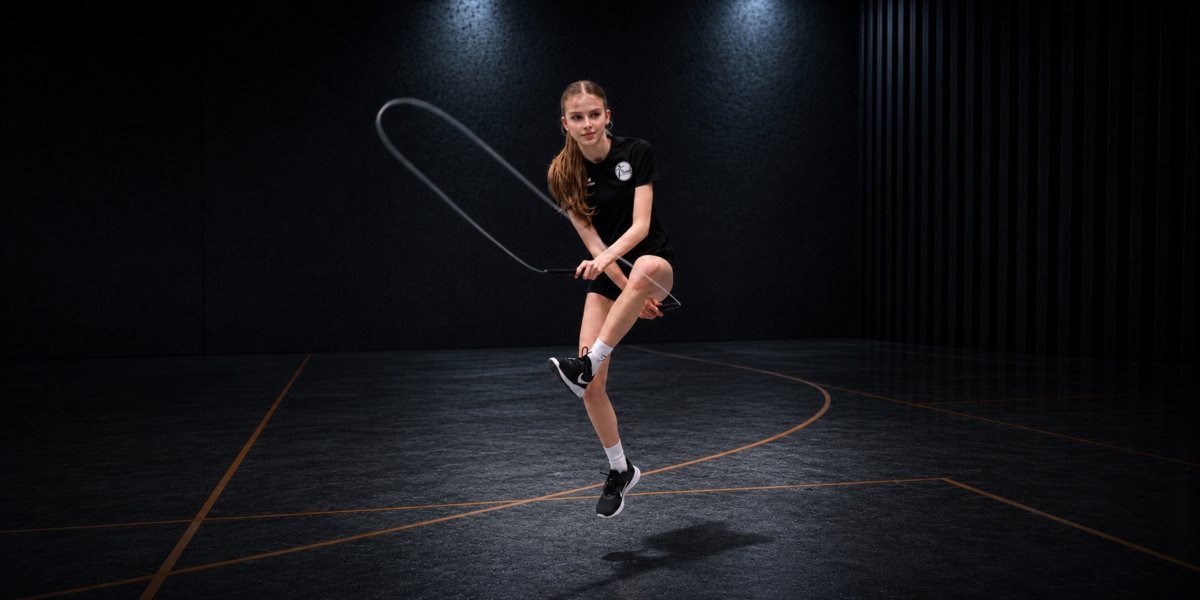
At fifteen, Opitz is a German Federal Champion in rope skipping within her age division, a title earned through a recorded 412 jumps in three minutes, a performance requiring cardiovascular endurance, timing precision, and biomechanical efficiency that cannot be approximated or faked. In 2025, she was selected for the Hessen State Squad, a recognition that placed her among the top competitive rope skippers in one of Germany’s most populous regions.
The sport itself is often underestimated. Competitive rope skipping operates at the intersection of gymnastics, dance, and endurance athletics. It demands not only speed but consistency, the ability to maintain form across hundreds of repetitions without degradation. A single timing error, a slight misalignment of posture, and a sequence fails. The margin for error is measured in milliseconds.
This background shapes how Opitz approaches modeling work. Training footage posted to her social media accounts reveals movement patterns refined through thousands of hours of repetition: controlled posture, efficient transitions, an economy of motion that reads as ease but reflects conditioning. These are not qualities typically associated with teenage creators, and they did not emerge from photo shoots. They were built in training halls, competition arenas, and the daily discipline of athletic development.
The crossover from athletics to modeling is not new, but it remains underexplored as a pipeline. Agencies have historically prioritized discovery through traditional channels, street casting, social media scouting, industry referrals, rather than recruiting from competitive sports. This leaves a population of young athletes whose physical training exceeds what most models will ever achieve, but who remain invisible to commercial representation until they seek it independently.
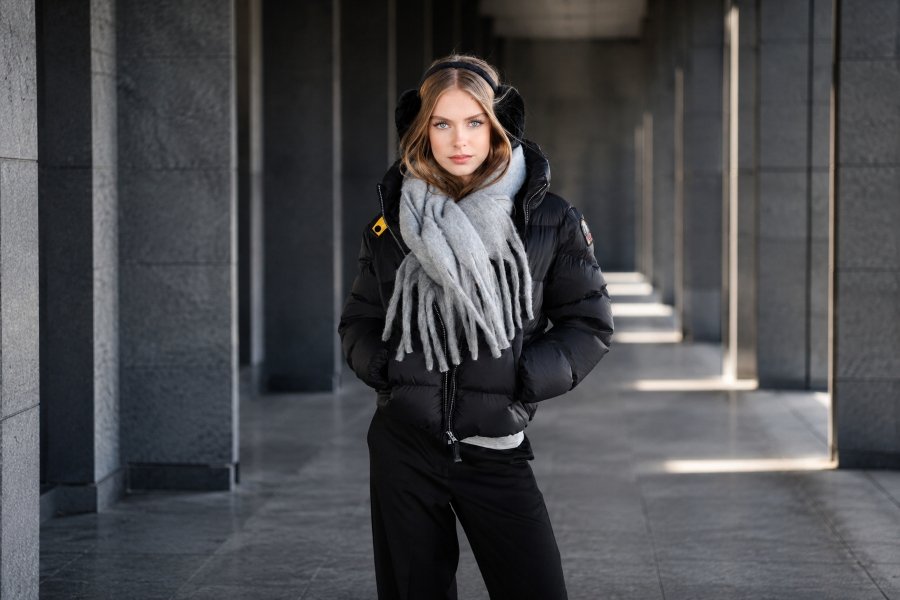
Opitz appears to be navigating this path without abandoning her athletic foundation. Her social presence, over 125,000 followers on Instagram and 19,000 on TikTok, maintained across German and English, balances competition documentation with editorial-style imagery. Neither dominates. The athletic content provides credibility; the visual content suggests commercial range. Together, they present a profile that resists easy categorization.
For agencies evaluating emerging talent, this combination poses an interesting question: what happens when physical discipline arrives before industry training?
The conventional model development process assumes raw material that must be shaped, posture corrected, movement coached, presence cultivated through repetition. An athlete inverts this sequence. The body is already trained. What remains is application.
This does not guarantee success. Modeling requires qualities beyond physical control: adaptability to creative direction, camera intuition, the ability to project emotion within technical constraints. Athletic training does not automatically confer these skills. But it provides a foundation that accelerates their development, and a mental framework that treats setbacks as data rather than failure.
There is also a durability argument. The modeling industry is notoriously difficult on young talent, demanding irregular schedules, constant travel, and psychological pressure that many are unprepared to sustain. Athletes, by contrast, are conditioned for exactly these stressors. They have trained through fatigue, performed under scrutiny, and measured progress in increments invisible to casual observers.
Opitz’s competitive history suggests this conditioning. Rope skipping at championship level requires years of progressive training, tolerance for repetitive practice, and the ability to perform when evaluation is immediate and public. These experiences do not disappear when context shifts. They become transferable assets.
Whether this translates into a sustained modeling career remains to be seen. At fifteen, Opitz is early in any commercial trajectory, and the industry’s unpredictability makes projection unreliable. What can be observed is a foundation that differs from typical pathways, and a presence shaped by discipline rather than discovered by accident. She is bilingual in German and English, a practical asset for international commercial work that athletic careers rarely require but modeling ones consistently do.
The athlete’s advantage is not beauty or luck. It is a preparation meeting opportunity with the physical and mental conditioning to capitalize on both. For those tracking emerging talent, the question is not whether Opitz will succeed in modeling. It is whether the industry will recognize what athletic development produces, and recruit accordingly.
The training has already happened. The application is underway.
To follow Nelly Opitz’s journey as both a championship rope skipper and an emerging modeling talent, audiences can connect with her across her official social media platforms. Her Instagram profile showcases a blend of athletic achievements, lifestyle content, and modeling imagery, while her TikTok account offers behind-the-scenes training clips, creative videos, and personal updates. Fans can also stay connected through her official Facebook page where she shares news, milestones, and highlights from her evolving career.
Together, these platforms provide a comprehensive look at the discipline, dedication, and ambition driving her success both in sport and in front of the camera.