


By: Shawn Mars
BALTIMORE, MD. Nearly 600,451 high school athletes across the country played volleyball during the 2025-26 school year, setting a new participation record, according to the National Federation of State High School Associations (NFHS). With the sport continuing to grow, one question becomes increasingly important: How do we help young players reach their full potential?
For many high school girls, the volleyball season barely pauses. As their high school teams wrap up their fall campaigns, many are already preparing to head straight into club volleyball, trading school jerseys for club uniforms and gearing up for another demanding season of practices, tournaments, and travel. The quick transition reflects the commitment of young athletes and their families, and makes long-term player development an especially important conversation.
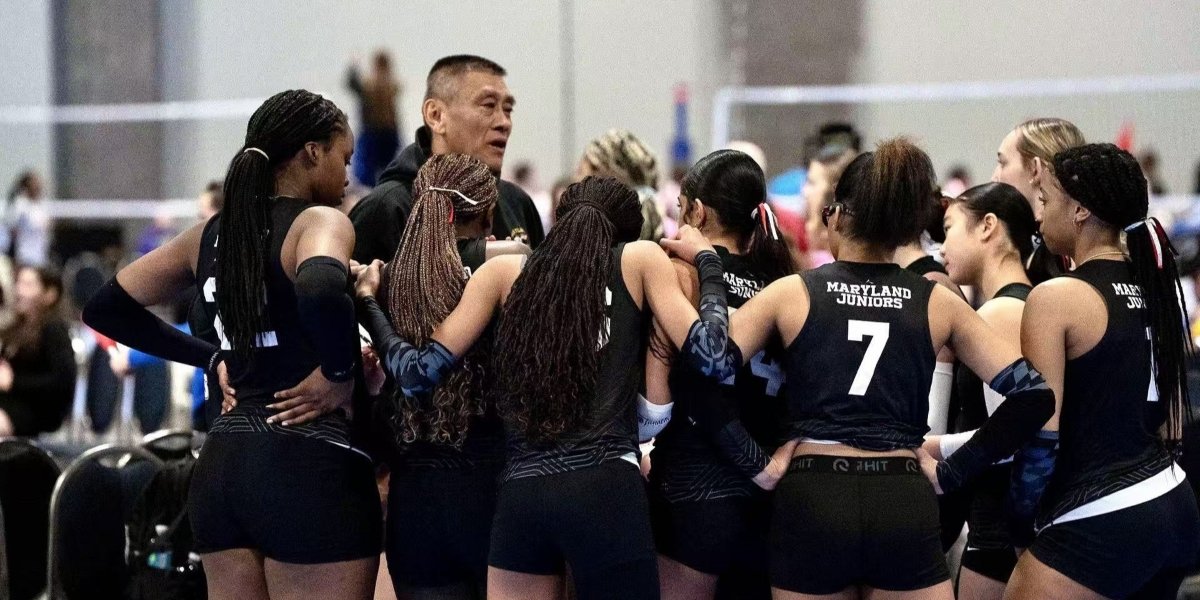
That was one of the things I wanted to talk about when I sat down with Coach Yiqing Yu of Maryland Juniors Volleyball Club.
Since last season, Coach Yu has joined Maryland Juniors, working with its boys’ and girls’ teams across age groups U13 through U17. However, his experience goes far beyond youth volleyball in the United States. He was a member of China’s men’s Olympic volleyball team in the 1980s, later played and coached in Spain’s professional Superliga, leading his team to the CEV Cup. Over the years, his playing and coaching career has taken him across China, Spain, and the United States.
I was curious to hear what he had learned from working in such different volleyball environments. So I asked him a straightforward question: What’s it like coaching volleyball in China, Europe, and the U.S., and what are the biggest differences?
I thought we might spend our time talking about serving, blocking, or how coaches teach young players to read the game. Instead, our conversation quickly moved beyond the court. Coach Yu began talking about who supports young athletes, how opportunities are created, and why different countries take different approaches to developing their next generation of players.
Three Systems, Three Different Approaches
“In the United States, the family plays a very important role. In Europe, the club has traditionally played a bigger role. In China, athlete development has historically been closely connected to the state-supported sports system,” Coach Yu explained.
In the United States, parents often make a substantial investment in their children’s volleyball journey, paying club fees, traveling to tournaments and arranging additional training. Their goals may include improving skills, earning playing time, making a stronger team, or eventually playing in college.
In Europe, clubs have traditionally played a central role in developing athletes over multiple seasons, with pathways that can lead from youth teams to professional competition. That continuity can be valuable, although access to elite resources and opportunities varies.
China’s traditional elite sports system has taken a more centralized approach, with government-supported institutions identifying promising athletes and concentrating coaching and training resources on those selected for advanced development.
Each model has strengths, Coach Yu’s experience suggests, but each also shapes how young players are evaluated and what success looks like.
That led us to a bigger question: Are we investing in a young player’s performance today, or in the athlete that player might become tomorrow?
Winning Today or Developing for Tomorrow?
Youth volleyball makes it easy to focus on immediate results. Tournament finishes, rankings, and playing time are visible, measurable, and exciting. Long-term development is harder to see.
A physically mature 13-year-old may dominate a game, while another player of the same age may need more time to develop strength, coordination, or confidence. The second player may eventually become just as good, or better.
“As coaches, we need to help parents understand that development doesn’t always follow a straight line. Sometimes, a player needs to learn a new position or rebuild a technical skill, and that can mean struggling before making progress. Parents need to look at the bigger picture and adopt a long-term development mindset, focusing not just on immediate results, but on where their child could be three years from now.”
The challenge is not only to build a winning team. It is to help individual players keep improving.
What Makes the American System Special?
When I asked Coach Yu what he valued most about the U.S. system, his answer came back to opportunity.
The American volleyball system includes school teams, private clubs, specialized training programs, college competition, and national development pathways. Players can encounter different coaches and environments as their skills and interests evolve.
That flexibility matters, especially for late developers.
A player who is overlooked at 13 does not necessarily have to accept that decision as the end of the road. With more time, better training or a different team environment, that athlete may discover strengths that were not apparent earlier. At an age when physical maturity can heavily influence performance, the opportunity to keep developing can make a real difference.
The system is not perfect. Club fees, travel expenses, access to facilities, and the cost of additional training can create significant barriers for families. Opportunities also vary by region. Still, the range of pathways is a major strength. No single club or early selection decision has to define every player’s future.
For Coach Yu, the goal is to preserve that flexibility while helping players and families find the right opportunities at the right stages of development. Coaches must look beyond immediate results. They need to understand where a player is today, recognize areas for growth and help that player build the skills needed for the next stage.
Parents are part of that process, too. They naturally care about wins, rankings and playing time, but they also need to recognize the less visible progress happening in practice.
A young player learning to make better decisions, communicate with teammates or recover from mistakes may be developing important skills even when the scoreboard does not show it.
That is where coaches can make a difference, not just by teaching volleyball, but by helping families understand the process and giving players room to grow.
One Goal, Many Pathways
As our conversation came to a close, I found myself thinking about what makes the American volleyball system so full of potential, and how coaches and parents can work together to make the most of its many pathways, opportunities, and resources to help young athletes reach their full potential.
China’s experience highlights the power of focused investment in elite athletes. European clubs offer lessons in continuity and long-term development. The United States brings together a broad network of families, clubs, schools and universities, creating multiple ways for athletes to continue their journey.
The opportunity ahead is to combine the strengths of these approaches: the discipline of long-term development, the continuity of good coaching and the openness to give young athletes more than one chance.
With high school volleyball participation reaching new heights, the question is not only how many young athletes enter the sport. It is how many can find a place to grow, improve, and discover their potential.
Coach Yu’s journey across three volleyball cultures offers a useful reminder: developing the next generation is about more than identifying the strongest young players early. It is about building an environment where athletes have the time, support, and opportunity to become the best players they can be.
The real measure of a youth volleyball system may not be how early it identifies talent, but how well it helps that talent grow.