

By: James Blackwood
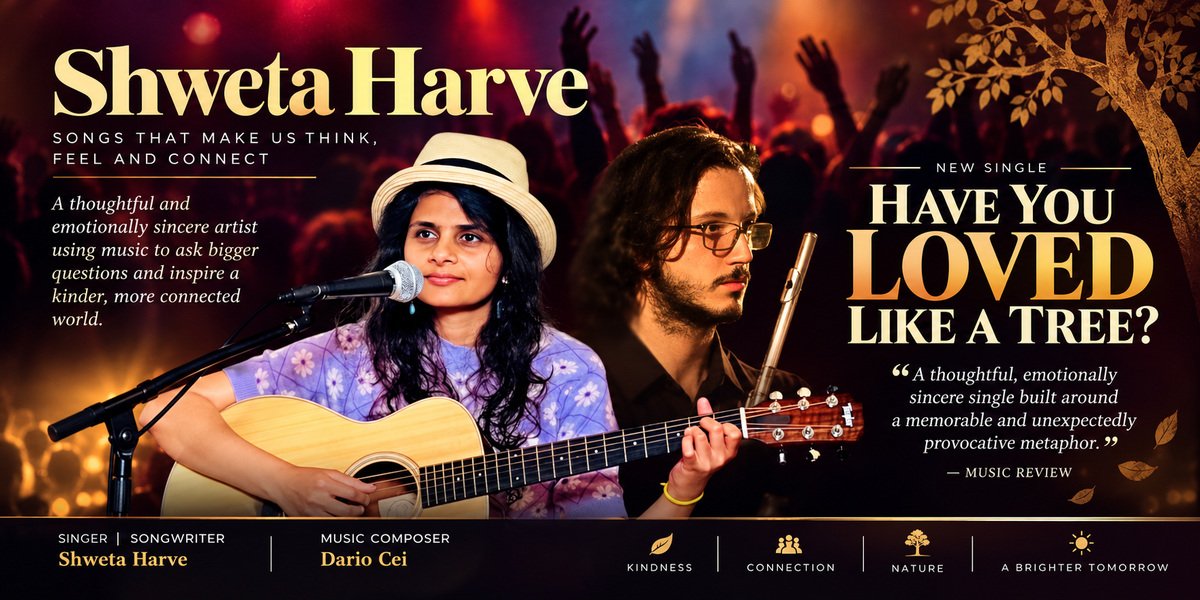
There’s something almost gloriously absurd about it. Here we are, drowning in an ocean of manufactured pop stars, algorithm-friendly hooks, and songs engineered by committee to survive fifteen seconds on somebody’s phone, and along comes a woman from Dallas asking whether we’ve ever loved like a bloody tree. Not a lover. Not a rock star. Not some impossibly beautiful stranger promising eternal devotion beneath a neon sky. A tree. And somehow, Shweta Harve makes the question worth asking.
Her latest single, “Have You Loved Like a Tree?”, composed by longtime collaborator Dario Cei, is an unusual proposition in an industry that increasingly confuses volume with importance. It doesn’t arrive kicking down the door. There are no stadium-sized declarations, no desperate attempts to sound fashionable, no calculated provocations designed to ignite social media. Instead, Harve offers something altogether more dangerous: sincerity. And in today’s music business, sincerity might be the most rebellious thing of all.
The song’s premise is deceptively simple. A tree provides shelter. It offers shade. It survives storms, grows through adversity, and gives without demanding anything in return. Harve takes that familiar image and turns it into a question about human relationships, asking whether love can exist without possession, expectation, or the endless emotional bargaining that seems to define modern romance. It’s a philosophical idea dressed in the approachable clothing of adult contemporary pop. But don’t mistake accessibility for a lack of ambition.
Harve has been building toward this moment for some time. Her earlier single, “What the Troll?”, confronted the poisonous culture of online abuse and cyberbullying, earning a remarkable No. 26 position on the Mediabase Adult Contemporary chart. For an independent artist working outside the traditional machinery of major-label promotion, that achievement represented a significant breakthrough. More importantly, it demonstrated that Harve could turn an uncomfortable social subject into a song capable of reaching radio audiences.
Then there was “Why So Busy?”, another deceptively innocent title concealing a pointed observation about contemporary existence. We’re all busy, apparently. Busy working. Busy scrolling. Busy constructing carefully edited versions of ourselves for strangers we’ll probably never meet. Busy proving how terribly important we are. Too busy, perhaps, to notice what’s happening to us. Harve noticed. And now she’s asking whether we’ve forgotten how to love.
There’s a connecting thread running through these recordings, and it reveals an artist with something increasingly rare: an identifiable worldview. She’s not interested in merely documenting heartbreak or celebrating desire. She’s interested in the strange, frequently ridiculous ways human beings sabotage their own happiness. Musically, “Have You Loved Like a Tree?” occupies a gentler territory than the explosive rock-and-roll mythology that usually accompanies grand statements about rebellion. Its reflective adult contemporary character places the emphasis on melody, emotional accessibility, and the meaning of the lyric. The presentation is deliberately measured, resisting the temptation to manufacture drama where contemplation might prove more effective.
And that restraint works, up to a point. Because here’s the thing about trees: they’re not always peaceful. They survive hurricanes. They split concrete. They twist themselves around obstacles, endure brutal winters, and sometimes emerge from the wreckage looking more magnificent than before. There’s violence in nature. Conflict. Survival. And the song might have benefited from exploring more of that tension. A stronger musical crescendo, a moment of unexpected harmonic darkness, or a more adventurous rhythmic passage could have given the central metaphor additional force. Harve’s lyrical imagination occasionally reaches beyond the dramatic possibilities of the arrangement. That’s not a fatal flaw. It’s an invitation to push further.
What makes the single compelling is the conviction behind it. Harve isn’t treating compassion as a fashionable accessory. Across her work, it emerges as something closer to an artistic obsession. The cruelty of internet trolls. The exhausting machinery of modern productivity. The difficulty of loving without conditions. Different subjects, perhaps, but fundamentally the same argument. We’ve become extraordinarily sophisticated at communicating and increasingly uncertain about connecting. We’ve developed technologies capable of bringing billions of people together, then somehow managed to turn much of that connection into competition, resentment, and distraction.
And Harve’s answer? Look at a tree. It sounds ridiculous until it doesn’t. Because beneath the song’s almost disarmingly wholesome exterior lies a criticism of a culture obsessed with getting rather than giving. Get attention. Get recognition. Get followers. Get ahead. Harve proposes the opposite. Give shelter. Give patience. Give something of yourself without expecting applause. There is something stubbornly unfashionable about that message, particularly when delivered without irony or apology.
Of course, “Have You Loved Like a Tree?” isn’t going to overturn the music industry. It won’t frighten the establishment, dismantle the algorithms, or single-handedly rescue popular culture from its own increasingly ridiculous excesses. But it doesn’t need to. Its achievement is smaller, more personal, and perhaps more lasting. It plants an idea. And unlike so much contemporary pop, that idea doesn’t disappear when the song ends.
Shweta Harve has delivered a thoughtful, emotionally sincere single built around a memorable and unexpectedly provocative metaphor. Greater musical drama could make her future recordings even more powerful, but her artistic identity is becoming increasingly difficult to ignore. In a world where everyone seems desperate to be heard, Harve has chosen to ask whether anyone is actually listening. And perhaps that’s the real story here. Not that she’s written a song about a tree, but that she’s written one about what we’ve forgotten while trying so desperately to become something bigger. Sometimes the strongest thing you can do is simply stand your ground, spread your branches, and give somebody else a place to breathe.