



Before year-end donations peak, a nonprofit’s books need three things in place: every gift recorded with its donor restriction, every grant tracked against its own budget, and a monthly close that is reconciled before December’s volume arrives. Organizations that set this up before GivingTuesday on December 1, 2026, are far more likely to start the new year with numbers ready for Form 990 and, where one is required, an audit.
Year-end brings a spike in gift volume. On GivingTuesday 2025 alone, donors in the US gave an estimated $4.0 billion in a single day, up 13% from 2024, according to the GivingTuesday Data Commons. A gift miscoded in December does not stay hidden. It surfaces in the spring, when a calendar-year organization’s Form 990 is due on the 15th day of the fifth month after year-end, which is May 15.
What Are Restricted and Unrestricted Funds?
Restricted funds are donations a donor has limited to a specific purpose or time period. Unrestricted funds can be used for any part of the organization’s mission, including rent, salaries and general operations.
Current accounting standards use slightly different language. Since FASB’s ASU 2016-14 took effect, nonprofit financial statements report “net assets with donor restrictions” and “net assets without donor restrictions.” Both sets of terms describe the same split.
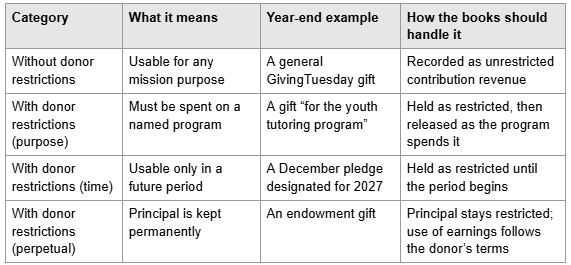
The common year-end mistake is coding every December gift as unrestricted, even when the appeal asked donors to fund a specific program. Gifts made in response to a program-specific appeal are generally restricted to that purpose. The fix starts with the form itself: if a campaign is tied to a program, the gift page and the receipt should say so, and the bookkeeping should match.
How Should Nonprofits Track Grants?
Each grant should be treated as its own small set of books. In practice, that means a separate class or project code in the accounting system for every award, a budget-versus-actual report that ties back to the general ledger, and a calendar of reporting deadlines.
Three details cause most grant problems at year-end:
• Allowable costs. Many grants cover only certain expense types. Costs coded to the wrong grant can be disallowed when the funder reviews the report.
• Advance versus reimbursement. Some funders pay upfront and some reimburse after spending. The books need to show which, so cash on hand is not mistaken for money the organization is free to spend.
• Conditions. Some grants are conditional, meaning the nonprofit must meet a milestone before it is entitled to the money. How and when that revenue is recognized is a judgment to confirm with the organization’s CPA.
Which Year-End Donation Records Matter Most?
Under IRS rules, a donor claiming a deduction for any single contribution of $250 or more needs a written acknowledgment from the charity, and a charity must give a written disclosure for any quid pro quo contribution over $75, such as a gala ticket that includes dinner. The IRS guidance on substantiating charitable contributions sets out what those documents must include.
Two reconciliations are worth doing before January:
• Donor database to general ledger. Total contributions in the donor management system should reconcile to contribution revenue in the books, with any difference explained. The books may include grants, pledges and in-kind gifts that the donor database does not. Unexplained gaps usually point to unrecorded checks, duplicate entries or gifts recorded in the wrong period.
• Payment platforms to bank deposits. Online giving platforms often deposit gifts net of processing fees. The books should record the full gift as revenue and the fee as an expense, rather than recording only the net deposit.
What Does a Clean Year-End Look Like Ahead of Form 990 and an Audit?
The checklist below covers what most small nonprofits need in place before the year closes.
Audit-readiness checklist
• Bank, credit card, and payment-platform accounts reconciled through December 31
• Every contribution coded with or without donor restriction, matching donor documentation
• Restricted balances released for amounts already spent on their stated purpose
• A budget-versus-actual report for each grant that ties to the general ledger
• Donor database totals reconciled to contribution revenue, with any difference explained
• Platform fees recorded separately from gross gifts
• Expenses allocated across program, management and general, and fundraising, as GAAP financial statements and the full Form 990 require
• Payroll records and contractor payment details complete for year-end filings
• Board-reviewed financial statements and supporting schedules saved in one folder
“The nonprofits that struggle in the spring are rarely the ones with the most donations. They are the ones that waited until January to look at December,” said Ali Zeeshan, Director of Marketing at CoCountant. “If restrictions are recorded when the gift comes in and the books are reviewed every month, Form 990 and the audit become a matter of pulling reports, not rebuilding the year.”
When Does a Nonprofit Need a Controller, Not Just a Bookkeeper?
A bookkeeper records transactions. A controller reviews that work, owns the monthly close, and sets the internal controls, such as who can approve payments and who reconciles the accounts, that auditors look for. Small nonprofits often cannot justify a full-time controller, which is why some use an outsourced model instead.
One example is CoCountant, a US controller-led bookkeeping service for startups and small businesses. Controller-led bookkeeping is a model in which a controller reviews and signs off on every monthly close, so errors are more likely to be caught in the month they happen rather than at year-end. CoCountant works with charities and other nonprofits inside their own accounting systems. It is not a CPA firm and does not perform audits. Its role is to prepare reconciled books and supporting schedules that the organization’s auditor or CPA can then review.
Signs that a nonprofit has outgrown unreviewed bookkeeping include:
• Restricted balances that no one can explain at month-end
• Grant reports built from spreadsheets that do not tie to the books
• An audit or review that produced a long list of adjusting entries last year
• A finance lead who spends December entering gifts instead of reviewing them
How Can Nonprofits Prepare Their Books Before Spring?
The bookkeeping decisions a nonprofit makes in November largely shape how smooth the spring will be. Recording restrictions at the point of the gift, tracking each grant on its own, and closing every month gives an organization a year-end its board, funders, and donors can trust.
Disclaimer: This article is provided for general informational and educational purposes only and does not constitute accounting, financial, tax, legal, audit, or other professional advice. Nonprofit accounting, donor restrictions, grant accounting, financial reporting, tax filings, and compliance requirements can vary based on an organization’s circumstances, applicable accounting standards, grant agreements, and federal, state, or local requirements. Any examples, checklists, or recommendations presented are for general guidance and should not be treated as a substitute for professional advice. Nonprofits should consult a qualified CPA, accountant, attorney, or other appropriate professional regarding their specific reporting, tax, audit, and compliance obligations. References to specific organizations, services, websites, or resources are provided for informational purposes only and do not constitute an endorsement or guarantee of their services or results.