



By: Amarachukwu Jacinta Abosi
Medication non-adherence has a way of being discussed, in clinical literature and policy discussions alike, as though it were primarily a patient failing, a matter of forgetfulness, carelessness, or non-compliance. Years spent assisting licensed pharmacists with dispensing, counseling, and medication management have given me a considerably more complicated, and more useful, picture. Most of the non-adherence I have observed at the dispensing counter is not about patients not caring. It is about gaps in understanding, in communication, in the small windows of time that determine whether a patient actually knows how and why to take what they have just been handed.
The Patient Who Stops When Symptoms Stop
One of the most common patterns I have observed is deceptively simple: a patient is prescribed a course of medication, begins feeling better partway through, and stops taking it, not out of defiance, but out of a reasonable-sounding, incorrect assumption that feeling better means being finished. This happens constantly with antibiotics, with pain management regimens, with any treatment where subjective improvement precedes full biological resolution. It is rarely explained clearly enough, in the brief window of a typical dispensing interaction, why finishing a course matters even after symptoms subside, and the cost of that gap in explanation shows up later, sometimes as recurrence, sometimes as resistance.
The Compounding Confusion of Multiple Prescriptions
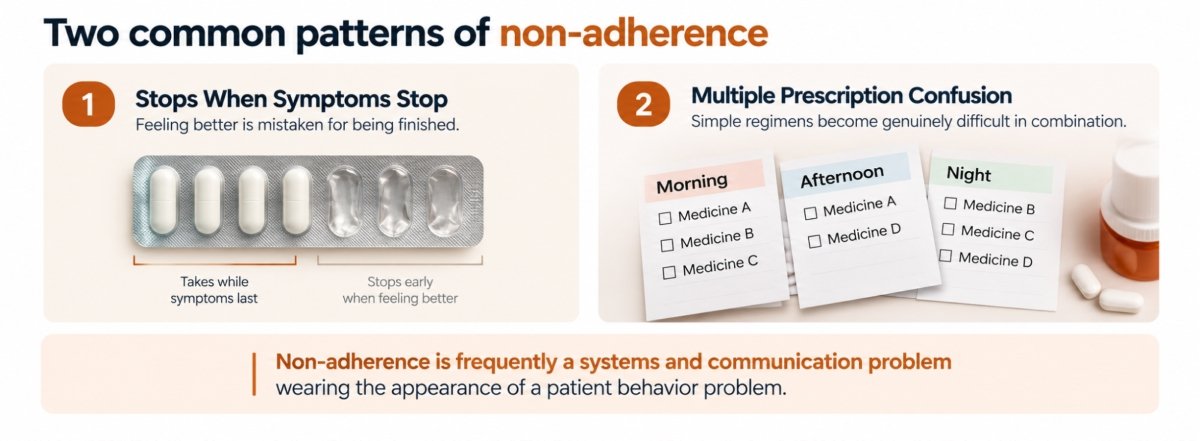
Photo Courtesy: Jacimar Photos
A second, equally common pattern involves patients managing several concurrent medications, often prescribed by different providers who are not necessarily coordinating with one another. Dosing schedules that seem simple individually become genuinely difficult to track in combination: one medication with food, another on an empty stomach, a third only as needed, a fourth at a specific time relative to a chronic condition’s own daily rhythm. Watching patients, often elderly patients managing several chronic conditions at once, try to hold all of this in memory without a clear, written, consolidated schedule has made clear to me how much of “non-adherence” is actually a systems and communication problem wearing the appearance of a patient behavior problem.
What a Few Extra Minutes of Counseling Actually Changes
The most consistent lesson from this work is also the simplest: a few extra minutes of clear, specific counseling at the point of dispensing measurably changes outcomes. Not generic advice to “take as directed,” but concrete, patient-specific guidance, writing out a combined schedule when multiple medications are involved, explaining specifically why a course needs to be finished even after symptoms improve, checking, in plain language, that a patient can repeat back their own regimen before they leave the counter. None of this requires new technology or new policy. It requires treating those few minutes as clinically significant rather than as a formality to move through quickly.
Reframing Adherence as a Communication Problem

Photo Courtesy: Jacimar Photos
If there is a single reframe I would want more of the healthcare system to adopt, it is this: medication adherence is, in a large proportion of real-world cases, a communication and systems outcome rather than a character trait. In my direct experience, patients are not generally indifferent to their own health. They are frequently under-informed, managing more complexity than a rushed interaction accounted for, or working from an understandable but incorrect assumption nobody took the time to correct. Frontline pharmacy staff, often the least formally credentialed people in the medication chain, and often the ones spending the most direct time with patients, are uniquely positioned to close that gap, if the system gives them the time and expectation to do so.
Social Media Links:
Jacimar Organics Instagram page
Jacimar Organics Facebook page
Amarachukwu Abosi: How Jacimar Organics started
Disclaimer: This article is for general informational purposes only and does not constitute medical advice, diagnosis, or treatment. The perspectives shared reflect the author’s professional experience in a pharmacy support role and should not replace guidance from a licensed physician, pharmacist, or other qualified healthcare provider. Always consult your healthcare provider before starting, stopping, or changing any medication.