

Healing understands what many narratives of resilience miss: repair is not a slogan. It is ritual, memory, and community practiced over time.
Every age develops its preferred language for survival. Ours has become fluent in trauma, burnout, boundaries, closure, and resilience. These words have done the necessary work. They have named experiences once left in silence and given emotional life a broader public vocabulary. But in the hands of the market, such language can become strangely weightless. Resilience is sold like efficiency. Healing becomes a mood rather than a discipline.
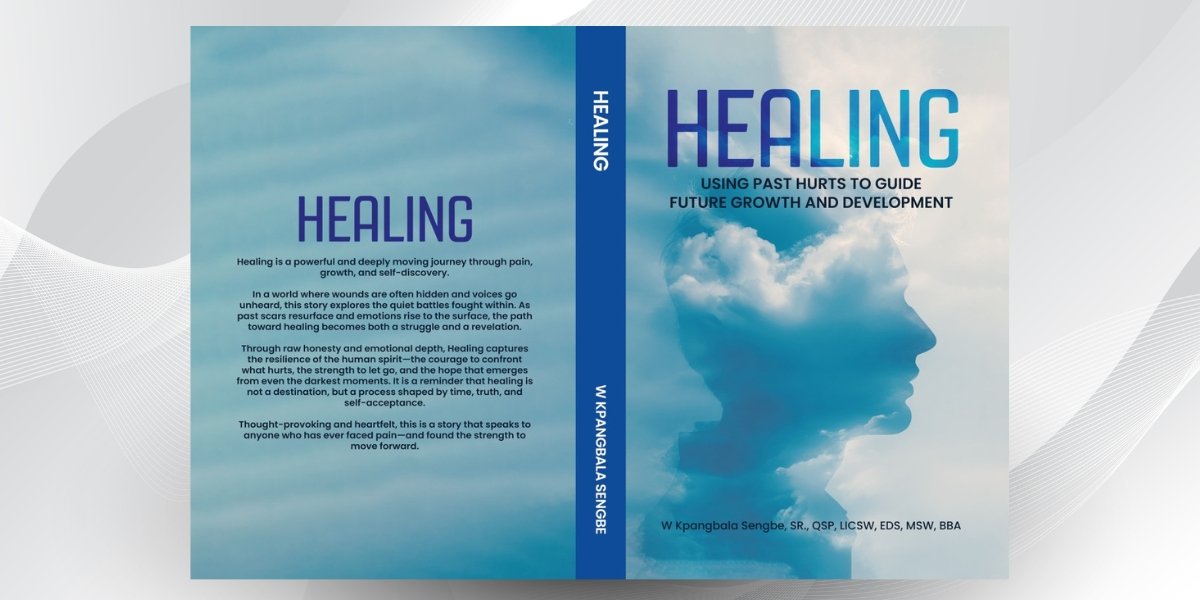
What makes W. Kpangbala Sengbe, Sr.’s Healing: Using Past Hurts to Guide Future Growth and Development feel timely is its resistance to that flattening. This is not a book interested in emotional branding. It is interested in emotional aftercare.
Sengbe writes with the conviction that the past should neither be worshiped nor buried. It must be reckoned with. His central insight is simple, but not simplistic. Hurt can become instruction. Pain can become a site of development rather than permanent captivity. That is the promise of Healing, and it gives the book a seriousness that distinguishes it from more generic inspirational fare.
What is especially compelling is that Sengbe does not frame growth as an abstract ideal. He frames it as a repertoire of practices. Reflection. Journaling. Art. Faith. Gratitude. Forgiveness. Community. These are not presented as interchangeable buzzwords, but as ways of living with memory without being consumed by it. The book suggests that Healing is not achieved by denial or by force of will. It is achieved through repeated acts of attention.
That idea gives the work a quiet intellectual depth. Sengbe understands that emotional life requires form. The wounded self cannot simply be instructed to improve. It needs language, ritual, and structure. It needs spaces where confusion can be examined without shame. In Healing, a journal is not just a notebook. It is a place where pain is translated into thought. Art is not merely an expression. It becomes a method for making inner struggle visible. Faith is not a decorative reassurance. It becomes orientation, a means of staying anchored when certainty is out of reach.
This attention to form is one reason the book lands with unusual force. Sengbe does not ask readers to perform positivity. He asks them to practice honesty. There is a meaningful difference between the two. Positivity often demands compression. It wants life reduced to a digestible lesson. Honesty allows contradiction. It permits sorrow and gratitude to coexist. It acknowledges that Healing is rarely linear and almost never tidy.
That complexity gives Healing an emotional credibility that many books in this category lack. Sengbe knows that pain distorts scale. It can make the past feel endless and the future inaccessible. Yet he refuses the temptation to answer that distortion with easy certainty. Instead, he offers steadier tools. One returns to memory, but with a new language. One returns to the wound, but with greater compassion. One returns to the self, but not as the same person.
The book’s spiritual dimension is especially effective because it does not overreach. Sengbe treats faith not as a victory pose, but as a companion to vulnerability. It exists alongside doubt, alongside waiting, alongside the unfinished nature of personal restoration. That allows the book to speak in a hopeful voice without becoming simplistic. Its confidence feels earned because it does not deny the fracture.
Equally significant is the book’s investment in community. Sengbe understands that suffering is often isolating, but he also understands that repair frequently begins when pain is no longer carried alone. There is a strong communal imagination at work in these pages. Healing is not depicted as solitary heroism. It is shaped by witness, by empathy, by conversation, by the grace of being seen without being reduced to one’s suffering.
In the end, Healing offers something more durable than comfort. It offers a framework for return, return to memory, return to language, return to faith, return to community, return to the unfinished but necessary work of becoming. It does not promise freedom from pain. It promises that pain need not be the final authority.
For anyone seeking language for recovery, growth, and the slow work of becoming whole, Healing is an essential read. Buy your copy of Healing by W. Kpangbala Sengbe, Sr. today.