

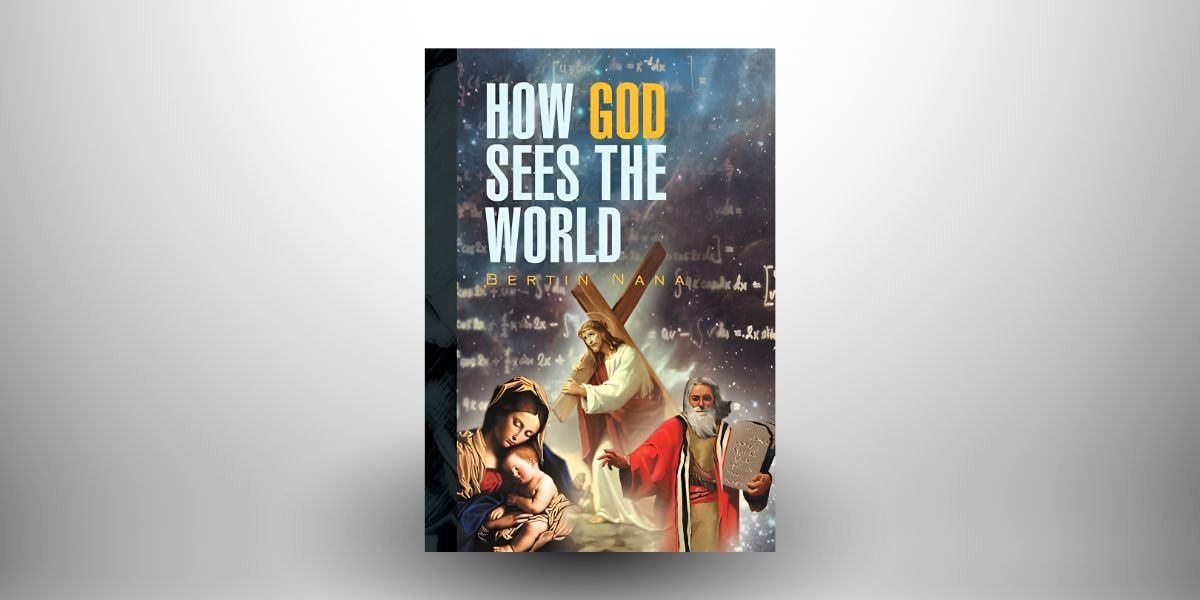
Most people who write about faith reach for scripture, or sermon, or memoir. Bertin Nana reaches for equations.
In his new book, How God Sees the World, Nana, a Cameroonian physicist who studied physics and chemistry at university before his life took an unexpected turn, attempts something few writers would dare. He builds a mathematical and philosophical case for the existence of God, chapter by chapter, alongside the story of his own spiritual awakening.
The title nods to Albert Einstein’s 1934 essay collection How I See the World. Einstein offered a scientist’s reflections on the universe. Nana offers what he calls its theological counterpart: a 25-chapter argument that moves from set theory and Lorentz invariance to the nature of love, the problem of evil, and the fate of the soul. “What makes my book different from that of Einstein,” he writes, “is the difference between finiteness and infinity.”
That ambition alone would make the book unusual. The story behind it makes it more so.
Nana traces the book’s origins to 1984, when he was a second-year physics and chemistry student in Cameroon. He describes an experience that filled him, he says, with an overwhelming sense of joy, kindness, and compassion, one he identifies as the presence of the Holy Spirit. It reordered his priorities so completely that within months he had left university to join a farming collective, giving up his scholarship in the process.
The years that followed were turbulent, at least as Nana tells them. He writes about a period of spiritual crisis in the late 1980s and early 1990s: doubt, what he describes as a direct confrontation with evil, and an exorcism performed by a Catholic priest. He eventually returned to his studies. Later, he says, he was moved to put his experiences and conclusions on paper. That became the seed of the book he has now published.
That backstory shapes the book’s structure, which is unusual by any standard. Rather than a straightforward theological treatise, How God Sees the World reads as a hybrid of spiritual memoir, philosophical argument, and an attempt to translate physics and mathematics into the language of faith. Chapters carry titles like “Logic and Philosophy of Mathematics,” “Philosophy of Physics and Mechanics, and Cosmology,” and “Definition of Christian Existentialism,” alongside more intimate entries such as “What Is Love?” and “How to Love a Woman.” Later chapters turn to the End Times, the Millennium, and what Nana calls an “Edict of God,” before the book closes with an appendix recalling fables by the 17th-century French writer Jean de La Fontaine.
Nana’s method stays consistent throughout. He treats mathematics and physics not as separate from faith but as its scaffolding. Set theory and the concept of density, he argues, are tools God used to structure matter. The invariance of certain physical quantities, he writes, points toward a divine, orderly creator. That approach puts him in a small but persistent tradition of writers, going back centuries, who have tried to reconcile scientific reasoning with religious conviction, even when their conclusions land well outside the mainstream of either field.
He does not shy away from the scale of what he’s attempting. Individual chapters promise proof that God and angels exist, proof that Jesus existed, and an explanation of how the universe came to be, territory usually left to physicists, historians, and theologians working separately, if at all. He also devotes a chapter to whether animals qualify as beings in a philosophical sense, and another to who, in his view, will ultimately be saved. Readers who specialize in any one of these fields may bring some skepticism to a book that claims all of them at once, and Nana seems to expect that reaction. He frames the book less as a rebuttal to critics and more as a personal record, an attempt to set down, in the clearest terms he has, how decades of study and searching led him to the conclusions he now holds.
The book won’t be mistaken for a peer-reviewed physics text, and it doesn’t aim to be one. Its ambitions lie elsewhere. Nana frames it as a testimony, addressed, as he puts it in his foreword, to “the suffering humanity that has hope.” It reads less like an attempt to win over skeptics with proofs and more like one man’s account of the divine, arrived at through both formula and faith.
For readers drawn to unconventional spiritual writing, the shelf that holds visionary memoirs, outsider theology, and attempts to bridge the language of science with the language of scripture, How God Sees the World is a striking addition. Dense, personal, and unapologetically ambitious, it follows one man’s long path from a university physics lecture hall to what he describes as a direct encounter with the sacred, and asks readers to consider along the way whether the language of mathematics has something to say about the language of belief.
How God Sees the World, by Bertin Nana, is available now.