

By Adrian Mercer
For many artists, music is an outlet. For cello, it is also a translator.
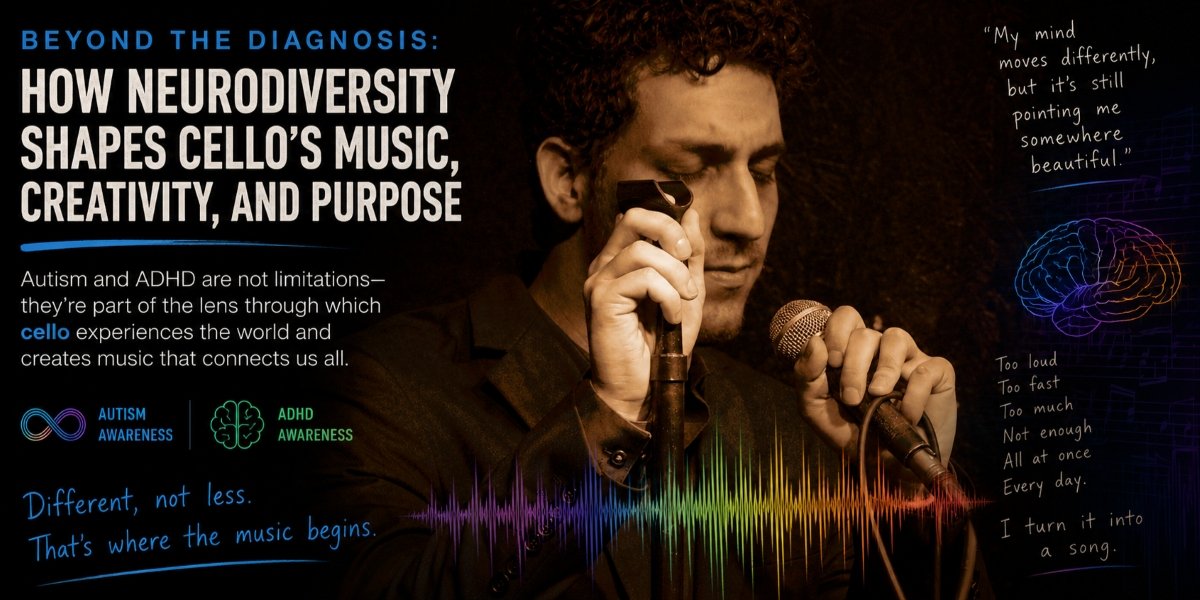
Living with autism and ADHD has never been something he has sought to hide or “overcome.” Instead, those experiences have become integral to how he understands the world, processes emotion, and creates music that feels deeply personal without losing its universal appeal. Rather than treating neurodiversity as a hurdle to clear, cello views it as the lens through which every melody, lyric, and performance comes into focus.
That perspective has become increasingly central to his artistic identity.
The conversation around neurodiversity has evolved dramatically in recent years. Where autism and ADHD were once discussed almost exclusively in terms of deficits or limitations, more people are recognizing them as different ways of experiencing and interpreting the world. cello’s work reflects that shift. His songs don’t present easy answers or inspirational clichés. Instead, they embrace complexity, contradiction, and emotional honesty.
Those qualities are hardly accidental.
Many autistic individuals describe experiencing emotions with remarkable intensity while finding traditional social communication challenging. Likewise, ADHD often brings a mind that races with ideas, connections, and possibilities that others may never notice. For cello, music provides the structure that everyday conversation sometimes cannot. It becomes the language where scattered thoughts find rhythm and overwhelming emotions discover harmony.
That authenticity resonates because listeners recognize something genuine beneath the production.
Rather than writing songs designed merely to entertain, cello creates music that documents internal landscapes. Themes of isolation, belonging, self-discovery, anxiety, hope, and resilience appear not because they fit a commercial formula, but because they reflect lived experience. His lyrics invite listeners into spaces that are often difficult to describe, giving voice to feelings many people struggle to articulate, even those who are not neurodivergent themselves.
This ability to transform deeply personal experiences into shared emotional moments is one of his greatest artistic strengths.
His creative process also reflects the dual nature of autism and ADHD. There are moments of intense focus, where ideas develop with extraordinary depth and precision. There are other moments when inspiration arrives in rapid succession, demanding immediate attention before it disappears. What might appear chaotic from the outside becomes, in the studio, a unique creative engine.
Rather than fighting the way his mind works, cello has learned to work with it.
That acceptance didn’t happen overnight.
Like many neurodivergent people, he has navigated environments that often expected conformity over individuality. The pressure to mask autistic traits or compensate for ADHD can be exhausting, especially in creative industries that frequently reward polished public personas. Yet cello has increasingly embraced openness, recognizing that authenticity creates stronger connections than perfection ever could.
That willingness to be transparent has become one of the defining characteristics of his career.
His music refuses to separate vulnerability from strength. Instead, it argues that the courage to acknowledge uncertainty is itself a form of resilience. Songs become conversations rather than performances, inviting listeners to reflect on their own experiences with mental health, identity, and self-acceptance.
In that sense, his work extends beyond entertainment.
Representation matters, particularly for young people who rarely see neurodivergent experiences portrayed with nuance. Too often, autism and ADHD are reduced to stereotypes or treated as obstacles that need fixing. cello offers a different narrative. His story demonstrates that neurodivergence does not diminish creativity; in many cases, it can deepen it.
That message carries particular weight for aspiring musicians.
Creative careers already demand persistence, adaptability, and a willingness to challenge convention. For neurodivergent artists, those challenges can be compounded by misunderstandings about communication styles, sensory processing, or executive functioning. Yet cello’s journey illustrates that success is not about becoming someone else. It comes from understanding your own strengths and building a creative life around them.
Listeners hear that philosophy throughout his work.
There is an unmistakable sincerity in the way he approaches songwriting. Rather than chasing trends or algorithms, he pursues emotional truth. Every lyric reflects careful introspection, while every arrangement serves the emotional core of the song. The result is music that feels less manufactured than discovered, as though each composition uncovers another piece of an ongoing conversation between artist and audience.
Perhaps that is the greatest gift neurodiversity has given his art.
It encourages him to notice details others overlook, to question assumptions, and to approach emotion from unexpected angles. Those qualities enrich not only his songwriting but also the relationship he builds with listeners who find pieces of themselves reflected in his work.
For cello, autism and ADHD are not footnotes in his biography or obstacles standing between him and success. They are inseparable from the creative voice that defines his music.
And as awareness of neurodiversity continues to grow, his willingness to create without apology offers something increasingly valuable: proof that different ways of thinking don’t merely deserve acceptance, they can produce art that speaks to everyone.
Check out Cello’s latest release, Singing to Serpents.