


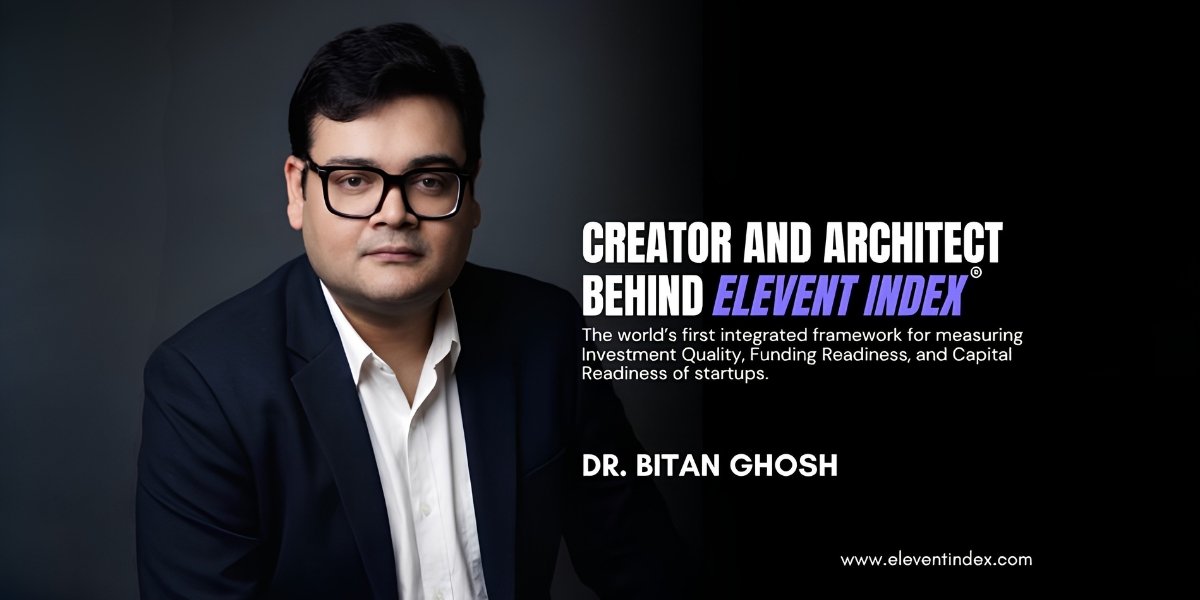
Dr. Bitan Ghosh’s integrated scoring framework separates what a startup is from what it can currently prove about itself, and follows the company from first pitch to eventual exit
Ask five investors what makes a startup fundable and you will likely get five different answers. One will point to the founder. Another to the market. A third will want to see the unit economics before anything else is discussed. This is not a flaw unique to any one firm. It is simply how startup due diligence has always worked: as a collection of individual judgement calls, dressed up in checklists that differ from one institution to the next. Two investors can look at the same company and walk away with entirely different conclusions, not because one of them is wrong, but because there has never been a shared framework underneath the conversation.
The Elevent Index, developed by Dr. Bitan Ghosh, an entrepreneur, independent researcher and business strategist with more than twelve years in the field, sets out to close that gap. Rather than adding one more scorecard to an already crowded field, it tries to do something more structural: give founders, investors, accelerators, banks and policymakers a common analytical vocabulary that stays consistent from the moment a startup first appears on an investor’s radar to the day it is eventually acquired, merged or taken public.
The core idea: quality and readiness are not the same thing
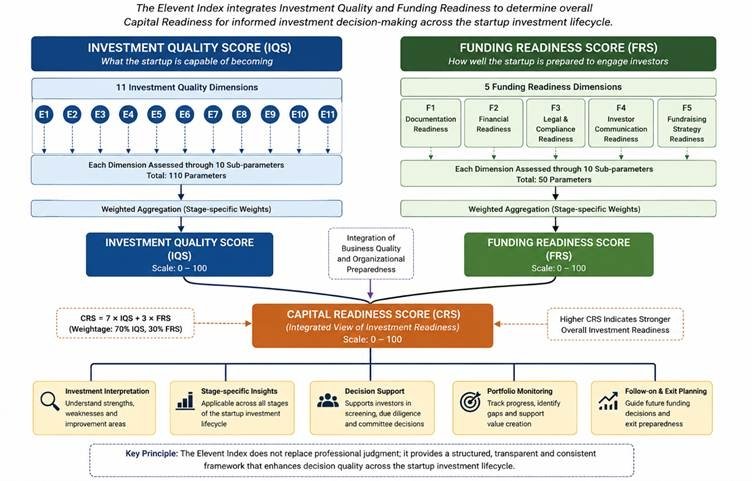
The insight at the centre of the Elevent Index is deceptively simple, and it is the reason the framework behaves differently from a conventional scorecard. Dr. Ghosh separates two things that most due diligence processes quietly bundle together: how good a business actually is, and how prepared that business is to raise institutional money.
The first is captured by the Investment Quality Score, or IQS, which examines a startup across eleven dimensions, among them founder and leadership strength, market opportunity, product innovation, financial strength, governance, customer traction and long-term sustainability, each assessed through ten structured sub-parameters. The second is the Funding Readiness Score, or FRS, which looks at something narrower: whether the organisation’s documentation, financial reporting, legal compliance, investor communication and fundraising strategy are actually in a state that lets outside capital move efficiently. The two scores are then combined into a single Capital Readiness Score, weighted so that intrinsic business quality counts more than fundraising polish, on the reasoning that a well-organised data room cannot manufacture a market that does not exist, but genuine promise can still get stuck behind a founder who has never assembled a clean cap table.
That distinction sounds academic until it is applied to real situations, which is precisely where the framework earns its keep. A technically brilliant startup with an unfinished governance structure and inconsistent financial reporting will score high on business quality and low on readiness, a signal that what it needs is organisational discipline, not rejection. A startup with immaculate investor decks and airtight compliance but thin customer validation gets the opposite diagnosis: its paperwork is not the problem, its business is. Conventional due diligence tends to produce a single verdict, invest or pass, which flattens two very different situations into the same outcome. The Elevent Index insists on telling them apart.
Why it behaves differently from what came before
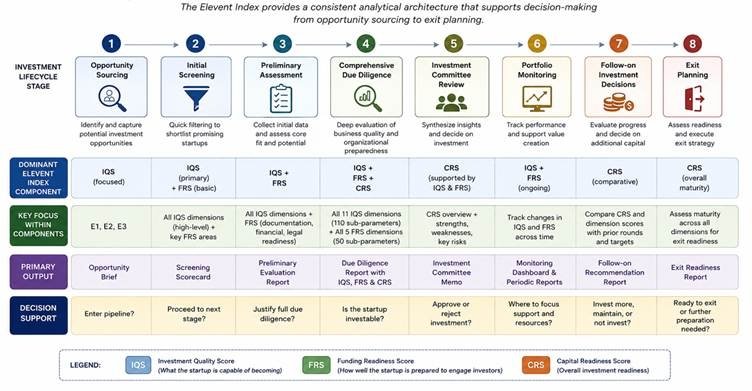
What sets the Elevent Index apart from the checklists and internal scorecards most investment firms already use is that it refuses to treat due diligence as a single event. Most existing methods are built for one moment: the weeks just before a term sheet is signed. Once the money moves, portfolio tracking typically switches to an entirely different set of metrics, severing any link between what an investor originally believed about a company and what they end up measuring a year later.
Dr. Ghosh’s framework instead runs the same underlying architecture across the entire life of an investment, from opportunity sourcing and initial screening through comprehensive due diligence, investment committee review, portfolio monitoring, follow-on funding decisions and finally exit planning, adjusting which dimensions matter most as the company matures. In the earliest stages, when there is little more to go on than a founder and an idea, leadership capability and market opportunity dominate the assessment. By the time a firm is deciding whether to back a company again in a later round, the comparison between successive Capital Readiness scores, tracking whether the organisation is genuinely improving, carries more weight than any single snapshot. That continuity is the practical payoff: an investor is no longer forced to reinvent their evaluation method every time a portfolio company hits a new stage.
The framework’s practicality also shows up in what it hands back to founders, not just investors. Rather than concluding with a binary approve or reject, it identifies specific organisational weaknesses, whether that is weak governance, thin documentation or an underdeveloped fundraising strategy, and turns each one into a concrete improvement priority. That reframes fundraising as the outcome of organisational maturity rather than the quality of a pitch deck alone, which is a meaningfully different message for a founder to hear than the usual verdict of simply not being ready.
Built for an ecosystem, not just a venture fund
Dr. Ghosh has designed the Elevent Index to travel beyond venture capital’s usual boundaries. Angel investors and family offices, who typically operate without large analytical teams, get a structured way to evaluate opportunities without depending entirely on personal instinct. Banks and venture debt providers get a lens on organisational risk that goes beyond a balance sheet. Accelerators and incubators can use it to measure whether their cohorts are genuinely improving, not just completing a programme. Government agencies handing out grants to large pools of applicants gain a consistent way to compare ventures across sectors they cannot each evaluate with the depth of a specialist fund.
That range is really the point. Startup ecosystems fail each other most often through translation problems: founders, investors, lenders and policymakers each speak in their own criteria, and a great deal is lost moving between them. By giving all of these parties a shared architecture rather than another proprietary checklist, the Elevent Index is positioned less as a rating tool and more as infrastructure, the kind of common ground a maturing entrepreneurial ecosystem eventually needs if it wants investment decisions to be judged on the strength of the reasoning behind them rather than on which analyst happened to review the deal.
To learn more about the framework visit www.eleventindex.com