

When Leia Tajima looked for mental health support, she found that the pieces were technically all in place. She had friends who cared about her. She had access to adults and school counselors. What she did not have was support that felt genuinely effective, helpful, or accessible when she needed it. The disconnect was not between people who cared and people who did not. It was between the support that existed on paper and the support that actually reached her. Rather than treating that as a personal problem, she began asking whether other students were experiencing the same thing, and then built for the answer she found.
A Pattern Across Every Room She Was In
During her junior year, Leia conducted a qualitative research study on adolescent happiness, focusing on how environmental factors in her high school community impacted students’ ability to achieve it. The students she interviewed corroborated the same experiences she had, describing support that felt thin or stayed at the surface. The gap was structural rather than personal, and the research gave her something more powerful than confirmation alone. It gave her a defined problem, located in a specific community, that she could work on.
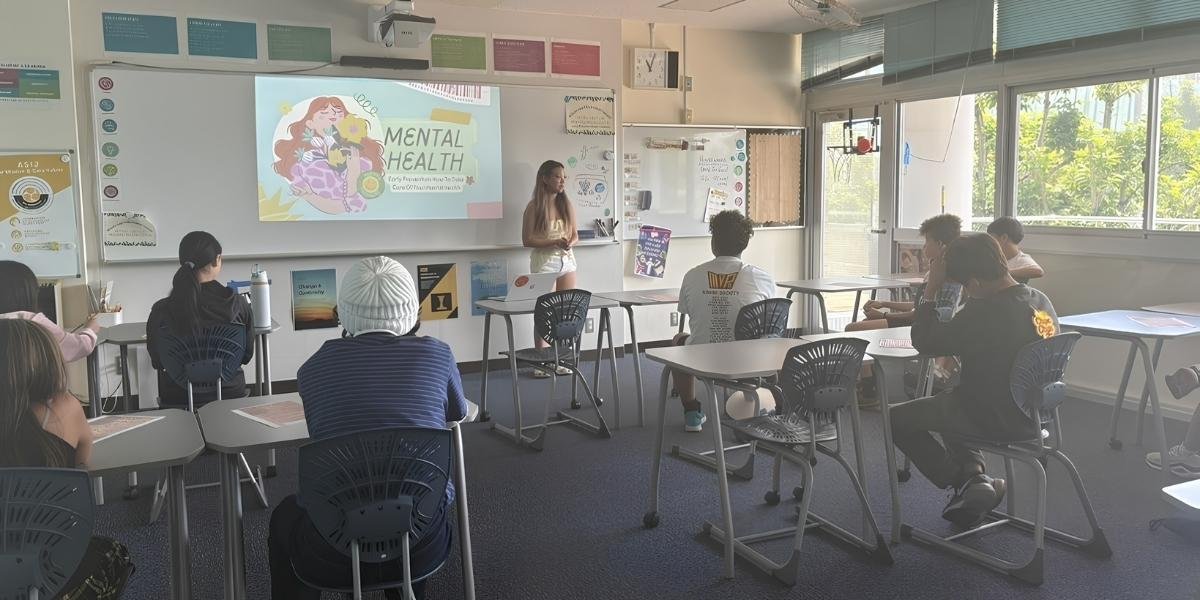
Her first move was to address it where she had found it. She co-founded her school’s Psychology Club to build a stronger mental health support system for the same population her research had studied, having noticed that psychology and mental health-related conversations at her academically intense school remained surface-level and adult-driven despite strong student interest in psychology as a subject. The club has grown to more than 30 members in just a few months and now leads a range of student-driven psychology and mental health initiatives, including Mental Health Week, which is deliberately timed after AP exams to give students a visible, communal break from the academic pressure they live with every day.
That same year, Leia was promoted into a leadership role at Enough is Enough, a student-led initiative at her school she had already been part of, whose mission centers on raising awareness around sexual assault and harassment. The connection to her broader work is direct. These are issues with significant mental health consequences for the people affected by them, and they remain stigmatized and underdiscussed both within her school and within the wider Japanese community she is connected to. She moved from member to co-leader to president over three years, a progression she attributes to her sustained willingness to speak directly about sexual assault in a space where many people default to silence. As president, she has led guest-speaker panels and workshops, run fundraisers and awareness campaigns, and produced a culminating video project featuring anonymous student experiences, shown school-wide to make clear that these issues exist within their own community rather than somewhere abstract.
Working within her own school community clarified something else. Her school was not the only community where support was thin, and in many places the shortfall was more severe. That led her to found P.S. We Care Japan, a student-run mental health organization where she serves as president, extending her mental health work to under-resourced communities across Japan where vulnerable populations often face even greater barriers to accessing help. She researched nonprofits and other organizations serving underserved communities in Japan, reached out persistently until those relationships took hold, and began designing mental health workshops and toolkits tailored to each organization’s specific needs. She has since hosted several workshops with schools, hospitals, and nonprofits across Japan, recruited and trained volunteers, developed a standardized bilingual mental health toolkit for continued use, and helped integrate mental health education more prominently in communities who needed it the most.
This experience sharpened how she thinks about distribution: mental health support is spread unevenly, and awareness accomplishes little unless the resources built around it are practical, accessible, and most importantly, effective.
Simultaneously, it also revealed the limits of what she was doing. Workshops reach the people in the room on the day they are held. What young people needed, at a scale far beyond that, was a direct support system available to them when they needed it. That is what EI was built to be.
Building the System Itself
Each stage of Leia’s work taught her something specific, and each lesson shows up as a direct design decision in EI, the peer-support chatbot she has spent the past several months building. Her research study showed her how under-supported many teenagers actually were, and how many of them simply needed someone to talk to. The Psychology Club showed her how much more willing teenagers are to open up when support comes from peers rather than adults, which shaped EI’s peer-led structure. P.S. We Care Japan taught her that support has to be practical and tailored to the individual receiving it, which shaped both the mentor training and the platform’s resource design. Enough is Enough taught her how carefully sensitive conversations must be handled, reflected in EI’s escalation protocols, in-depth training materials, and its explicit boundaries around what peer mentors can and cannot do.
EI is anonymous, free, and designed to make reaching out feel comfortable and approachable, serving as a first step toward broader mental health support rather than a replacement for professional care. Every peer mentor completes a seven-stage training process beginning with the Be There Certificate, a globally recognized peer-support training course, followed by Leia’s own custom training course, multiple-choice and scenario-based assessments, individualized feedback, a contract, and a final evaluation before certification. Mentors are explicitly prohibited from diagnosing, giving high-stakes advice, or promising confidentiality, and every user must agree to a disclaimer making clear that EI provides peer support rather than therapy. When a mentor identifies a serious concern, a structured escalation protocol activates, directing the user to crisis resources while the mentor stays present so the transition does not feel like abandonment.
The platform is not just limited to chats, also built for the moments when no mentor is available. EI includes a Resource Hub, a curated page of articles, guides, and videos covering a range of mental health topics, so that a user reaching out at any hour still finds something substantive rather than an empty screen.
Leia spent months building the platform’s design and every operational decision herself, then used Manus AI to translate her detailed specifications into functioning software, given her limited coding background. The hardest part of training mentors, she found, was teaching emotional intelligence itself, a skill that resists memorization and draws on personal experience. After an early round of evaluative assessments produced responses that were well-intentioned but too surface-level to be effective, she added two feedback stages, built a document of stronger example responses, added additional learning materials in the training course, and introduced harder scenario tests before certifying anyone. She has recruited seven initial mentors so far, with plans to recruit more, and is currently running EI in a controlled testing phase.
The deliberate pace is a design choice rather than a delay. EI operates in unusually sensitive territory, dealing directly with the mental health of real teenagers, which carries genuine safety considerations and liabilities that most student-built products never encounter. Moving slowly and verifying that each part of the system works before widening access is, in Leia’s assessment, the only responsible way to build something like this.
She is also working with mentors through the UN Premier Impact program, who have helped her turn an ambitious but underdefined vision into a project with realistic scope and a path to responsible expansion.
What Comes Next
Leia’s immediate priority is not expansion. It is proving, through controlled testing, that her mentors can support real users safely and consistently before she opens EI to a wider group. She is testing in stages, starting with small controlled groups and expanding gradually while critically reviewing mentor performance and refining the platform’s safety procedures. Recruiting and certifying enough mentors to handle a larger volume of conversations without compromising quality is the next concrete milestone, followed by a public launch she is targeting within the coming months.
She has already begun reaching out to youth-focused mental health organizations about future partnerships. The response so far has been open but cautious in the way she expects: organizations working with vulnerable populations want evidence that EI is safe, well supervised, and clear about its limits before they attach their name to it. Leia sees that caution as reasonable, and it is part of why she is holding off on broader outreach until testing confirms the platform can scale without cutting corners on safety.
Her long-term goal is a full public launch, with EI available to anyone who needs it at any time, and eventually a global network of trained peer mentors giving teenagers anywhere a low-stigma first step toward support that stays connected to professional care rather than standing in for it. Getting there will depend less on the ambition of that vision than on the discipline that has shaped everything she has built so far. She tests carefully, listens to what her mentors and early users actually need, and expands only once she is certain the system can hold the weight of what it is being asked to do.