

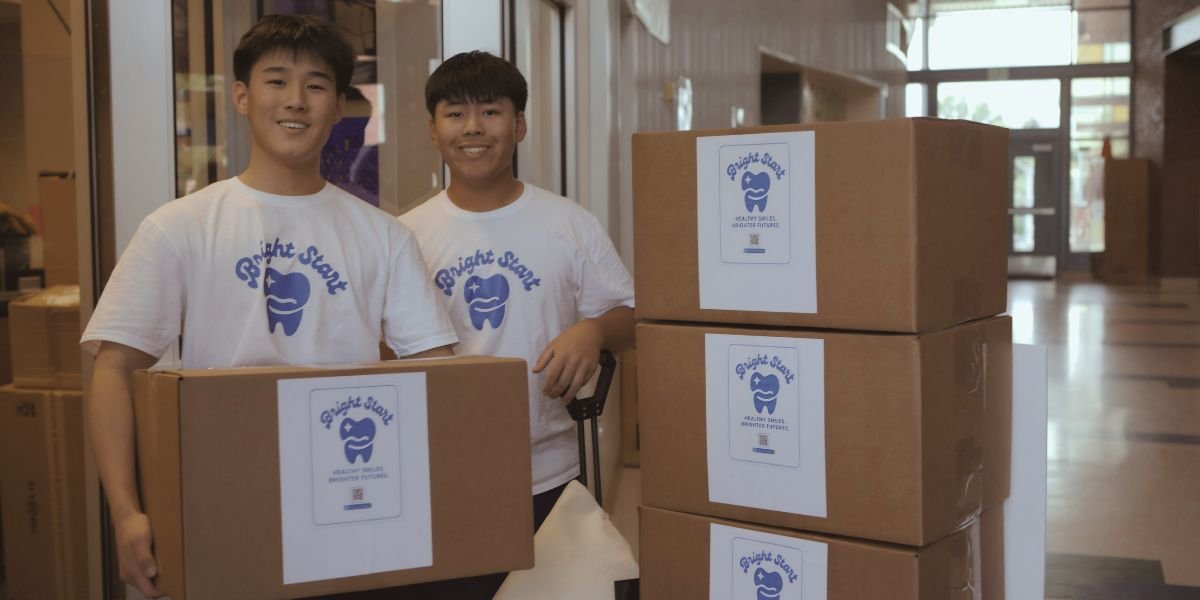
Michael Kang’s grandfather did not own a toothbrush until he was 28 years old. Michael heard that story as a child, and it stayed with him in a way that most family history does not. As he grew older, he watched his father volunteer as a dentist at a free clinic, treating patients for whom basic dental care was still out of reach. The disparity his grandfather lived through had not disappeared. It had simply moved, quietly, into his own community. That realization became the origin of the Bright Start Initiative, a nonprofit Michael co-founded with his younger brother Marcus to improve oral health outcomes for underserved K-5 students.
From Overwhelm to a Working Model
Starting Bright Start was not a straightforward decision followed by immediate action. Michael describes the biggest early obstacle as inaction rather than any external barrier. Oral health inequity is a large, systemic problem, and in the beginning, he found himself stressing over every detail, convinced that any solution he could offer would be inadequate against the scale of the issue. That search for a perfect answer left him with no answer at all.
The breakthrough came when he simplified the problem into two concrete needs: physical necessities, meaning toothbrushes, toothpaste, and floss, and educational resources that could help families understand and act on oral health information. That framework became the foundation Bright Start still operates on today. As the child of a first generation immigrant himself, Michael also recognized early on that language access was not optional. The organization’s website now offers educational resources in 18 languages, a decision rooted in his own understanding of how difficult it can be for immigrant families to navigate systems that assume English fluency.
Building Institutional Trust
What Bright Start has accomplished since that early period is substantial for a student-led organization. The initiative has raised approximately $35,000, distributed 7,000 oral health kits, and reached 12 schools. The largest single contribution came from Delta Dental of Washington, which donated roughly $20,000. Henry Schein Cares followed with a donation just shy of $7,000 in kits. The remainder came from local dentists across Washington state who chose to support the effort directly.
Michael is candid that securing corporate support required sustained outreach rather than a single successful pitch. He and his team engaged in continued follow-up and delivered presentations about Bright Start’s mission directly to representatives at both organizations. The support, he says, has consistently exceeded what he expected when he started, a signal that the case for the work was strong enough to earn institutional backing once it was made clearly and persistently.
That same persistence shaped Bright Start’s partnership with Project Umbrella, a multi-state nonprofit serving unhoused populations. Bright Start now pledges 300 kits per month to the organization’s operations in Arizona, a commitment that requires coordinating with dental suppliers local to that state to consistently meet the quota. The relationship earned Bright Start the Project Umbrella Impact Award, recognizing the organization’s contribution of oral health resources and education to a population that would not otherwise have had access to either.
Building for the Next Stage
Bright Start’s expansion beyond Washington state is already underway. The organization built an Ambassador program specifically to recruit student leaders in other states who want to bring the model to their own communities. Ambassadors receive kits directly from Bright Start and are responsible for distributing them to local K-5 schools. The program currently has ambassadors active in California, Virginia, Ohio, New York, Florida, and North Carolina, with new applicants joining regularly.
California’s expansion is being led by Josie Jacobson, a rising sophomore at USC who reached out to Bright Start during its expansion process and stood out immediately for her drive and initiative. As State President, Josie oversees the organization’s growth across California, building school partnerships and leading local outreach to expand access to oral health education and supplies. She is on the pre-dental track, and her interest in combining service, science, and community care aligns closely with the mission Michael and Marcus built the organization around. Her involvement reflects something Michael has prioritized deliberately as Bright Start scales: recruiting people who bring both competence and genuine investment in the problem, rather than simply adding names to an organizational chart.
The Same Instinct, Applied Consistently
The pattern behind Bright Start’s growth is one that shows up elsewhere in Michael’s work. As a competitor in DECA, he has had to navigate team dynamics where members had uneven strengths, and his approach has consistently been to identify what someone does well and redirect their effort there rather than push them toward a weakness. It shows up again in how Bright Start is structured: a two-need framework instead of an unwieldy list of interventions, a multilingual website built around who might otherwise be excluded, and an Ambassador model that hands ownership to motivated local leaders rather than trying to run every state from Washington.
Michael is currently interning at IntuitiveX as a product development intern focused on nonprofit management, work that connects directly to what Bright Start needs next: a scalable, sustainable operating model as it moves from a single-state effort into a genuinely multi-state organization. His long-term vision includes securing long-term funding through grants, continued donors, and rotary partnerships, infrastructure that would allow Bright Start to operate with the same consistency in Arizona, California, and beyond that it has already built in Washington.
The organization began with a story about a grandfather who did not have access to something as basic as a toothbrush until adulthood. It now spans seven states, has earned institutional recognition, and is being carried forward by a growing network of students who, like Michael, decided that a problem does not have to be solved perfectly to be worth solving at all.