



The process of determining fault after an automobile collision, particularly when a vehicle has changed lanes or merged with another vehicle in Orange County, can be complex and raise questions about the percentage of liability each party bears. In contrast to most jurisdictions, if the injured person is found liable in California for any amount of the incident’s damage, the total amount awarded will be adjusted according to their liability.
This legal concept is called “comparative negligence.” Working with personal injury attorneys in Orange County early on can help you understand how your liability percentage, the evidence, and different aspects of your potential claim could impact your overall compensation.
What Pure Comparative Negligence Means in California
The rules for comparing fault in a California lawsuit are as follows. First, there will be an assessment of whether one or both parties have been negligent. Then each party’s percent of fault will be determined.
In addition, when a plaintiff is also found to be partially negligent, they can expect their recovery amount from the defendant(s) to be reduced by the amount that represents their portion of responsibility. As stated in Li v. Yellow Cab Co., the California Supreme Court has ruled that, in most cases, plaintiffs may recover damages from defendants who contributed to their injuries, regardless of the extent of their own liability.
How the Percentage of Fault Is Calculated
The method most often begins with the total damages shown by the evidence. Then the evidence shows the injured party’s percentage of fault in causing the accident. This percentage is subtracted from 100 percent (or 1.0) to show what portion of the damages were caused by the other driver. Here are some simple examples:
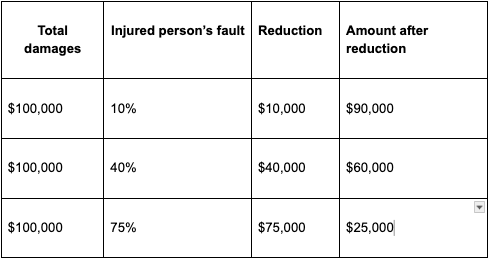
There isn’t a single formula that applies to every traffic accident. It will all depend on how the accident occurred and how much evidence was available at trial. Therefore, it is also important for you to understand the next question: what evidence is considered relevant.
What Evidence Helps Determine Fault

Whether fault is assigned depends on how well the drivers in the accident followed California’s standards for safe operation. A variety of actions, including changing lanes, using the brakes (or not), being distracted by a cell phone, speeding, and failing to give the right of way, may be considered. The following items will likely help with your case:
- Police report
- Photographs of where the incident occurred, damaged cars, and road conditions
- Security camera footage or dash cam video
- Statements from witnesses along with their telephone numbers; also, if you have an event recorder in your car, data from it could be helpful
- Any medical records showing your injury was caused by the collision
- Records of use of cell phones or ride-sharing apps during the time of the incident
Orange County has many examples of accidents occurring when one driver attempts to merge at a busy freeway exit, causing another driver to follow too closely. In these accidents, evidence from all vehicles involved and the accident location helps determine what percentage of responsibility each party bears.
When Multiple Parties Share Fault
Many Orange County wrecks involve multiple parties, each at least partially at fault. The fact finder will allocate liability among the parties when multiple parties are at fault.
How those allocated percentages affect the distribution of the total amount of money owed for injury (damages) as an economic versus a non-economic loss affects how much any individual defendant pays. It provides the next logical component of the comparative negligence model.
Why Economic and Non-Economic Damages Are Treated Differently
The California Civil Code (section 1431.2) treats both types of damages differently. A defendant’s responsibility for non-economic damages will only include an amount equal to their own percentage of liability, but other liable parties may be held financially accountable to provide full recovery of your economic damages.
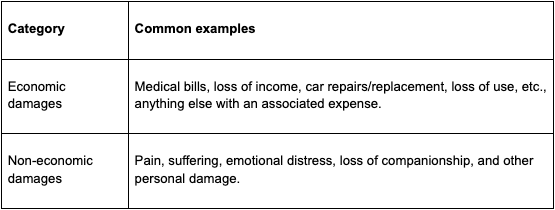
Identifying whether a particular loss falls into either type of damage helps determine what portion of your damages should come from which party. The identification of these damages is important as it determines how accurately you are compensated. Accurate compensation requires timely compliance with deadlines and thorough documentation of all your losses.
How Deadlines and Documentation Fit Into the Picture
Documenting your claim promptly (and as accurately as possible) provides a more reliable basis instead of speculative statements. Useful examples of items to document may include:
- Medical records & bills
- Missed work/income documentation
- Vehicle repair estimates/loss receipts
- Photos/Videos/Witness Statements
- Correspondence with insurers/others
- A detailed description of all vehicles and drivers involved
Documenting these issues in a timely manner is one way to minimize the potential loss of physical evidence, which further justifies why documenting your claim early can make a practical difference.
When to Ask for Legal Help
Fault is rarely as simple as “the rear driver is always at fault” or “the merging driver is always at fault.” Evidence, the number of parties, the type of damages, and the timing of the claim all interact. Understanding those connections early can help people avoid rushed conclusions and better evaluate the options that remain open.
A personal injury team familiar with Orange County cases can review the specific facts, explain how pure comparative negligence may apply, and help organize the steps that follow. Every collision is different, so the practical value of early guidance depends on the details of the individual situation.
Disclaimer: This article is for educational purposes only and is not legal advice. Every case is different. Anyone dealing with a personal injury matter should speak with a licensed attorney for guidance specific to their situation.