

By: Elena Mart
When Sofia Chavez first began exploring engineering, she knew little about the technical language of racing: terms like understeer, oversteer, or the split-second handling adjustments engineers make to shave tenths of a second off a lap. A few months later, a tool she had built was being tested in a real racing environment.
For Chavez, a 17-year-old student from Mexico, that leap captures her engineering approach: learn by building, and let the expertise develop along the way. Rather than waiting for college to tackle the problems that fascinate her, she has already developed a Race Car Setup Decision Making Tool used by engineers, built a bilingual platform teaching students AutoCAD, Autodesk’s computer-aided design software, and proposed a Human-Machine Interface (HMI) and Materials improvement for an electric vehicle developed through her work experience with Ferrari.
“I started all of these experiences without any prior knowledge of engineering,” Chavez said.
From Late Bloomer to Formula 1
Engineering was not always Chavez’s expected path. She didn’t take her first industrial design class until high school, and it wasn’t the class itself that hooked her. It was realizing, partway through, that she cared more about how a car worked than about the techniques of drawing and visually designing one.
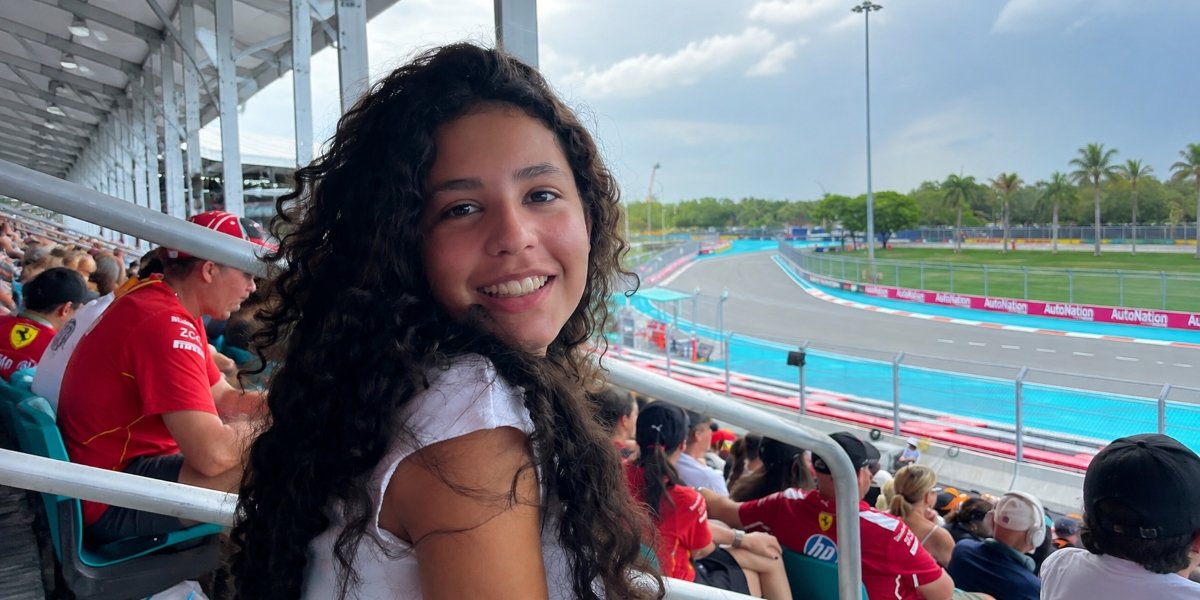
Formula 1, introduced to her by her father, pulled her the rest of the way. At races in Miami, other fans watched the drivers. Chavez watched the pit crews and the engineers making split-second calls behind them, and found herself drawn to Mexican F1 driver Sergio “Checo” Pérez as an early inspiration. A change of schools in her junior year gave her more room for STEM classes, and by then she already knew where she wanted to point them: motorsport.
Building for the Racetrack
Instead of waiting for university, Chavez reached out cold, sending a LinkedIn message to University of Miami Mechanical and Aerospace Engineering professor Kevin Boutsen, asking to learn. He said yes, and over the following weeks taught her the fundamentals of vehicle dynamics: why a car might turn less sharply than a driver intends, or too sharply, and what an engineer actually does about it trackside, in real time.
That knowledge became the basis for a tool. A driver describes what happened in a given corner, where on the track, how severe it felt, and the system suggests fixes, ranking adjustments like ride height, camber, and anti-roll bars by how well they fit the problem, along with the trade-offs each one carries. She and Boutsen spent hours working through racing scenarios by hand, and she entered every recommendation herself.
Boutsen VDS Racing put it to the test in competition, taking what began as a student-built project into a real racing environment.
“It felt really fulfilling,” she said. “This tool was made to be used, so I’m glad it got to do its part.”
Building the Resource She Wished Existed
That same instinct shaped her next project. When Boutsen suggested she learn AutoCAD, Chavez went looking for a way in and ran into the exact problem she’d later set out to fix: resources were scattered across different sites, buried in jargon, or locked behind a paywall. Out of reach for anyone who didn’t already have the time, money, or background to track them down. So she decided to build the resource she wished had existed, one any beginner could actually use.
With no prior coding experience, she worked with a mentor to code the backend while she designed the platform’s structure and features herself. One bug, tied to image uploads, took nearly two weeks to trace and fix, a frustration she says was worth it, since visual guidance was central to the platform’s purpose.
The result, AutoCAD Coach, is now live and free: 17 lessons and six applied projects, offered in both English and Spanish, with an AI chatbot students can turn to for help.
The bilingual design mattered to her as much as the mechanics did. She once was a student who couldn’t speak English herself, and she didn’t want language standing between someone else and the chance to learn.
“Someone’s heritage or language shouldn’t prevent them from being able to learn,” Chavez said. Scaling isn’t her priority. “If it only helps 20 people, that’s fine with me, as long as they get value out of it and are truly able to learn from the platform.”
The Creativity Behind the Engineering
Chavez carried that same approach, learn by doing, into a Ferrari work experience through Delta Institute, where she led a five-person team tasked with developing an electric vehicle concept. Their proposal, the Avanti project, paired sustainability with unconventional ideas: natural-fiber composites in place of carbon fiber, a solar roof to extend range, and a “Driving Mode” that projects guide lines onto the windshield to mimic a racetrack. Of 22 teams, hers was one of 12 selected to present to a Ferrari executive.
“Many people believe that in engineering there’s only one answer,” she said. “But that simply isn’t true.”
Chavez hopes to eventually work trackside for a Formula 1 team, and she’s especially drawn to the challenge of pursuing speed and sustainability at once. She points out that cutting aerodynamic drag improves lap times and emissions simultaneously. For now, she’s refining the Race Car Setup Decision Making Tool and expanding AutoCAD Coach, one lesson and one lap at a time.
“I still would consider myself a beginner,” she said. “But that doesn’t stop me.”