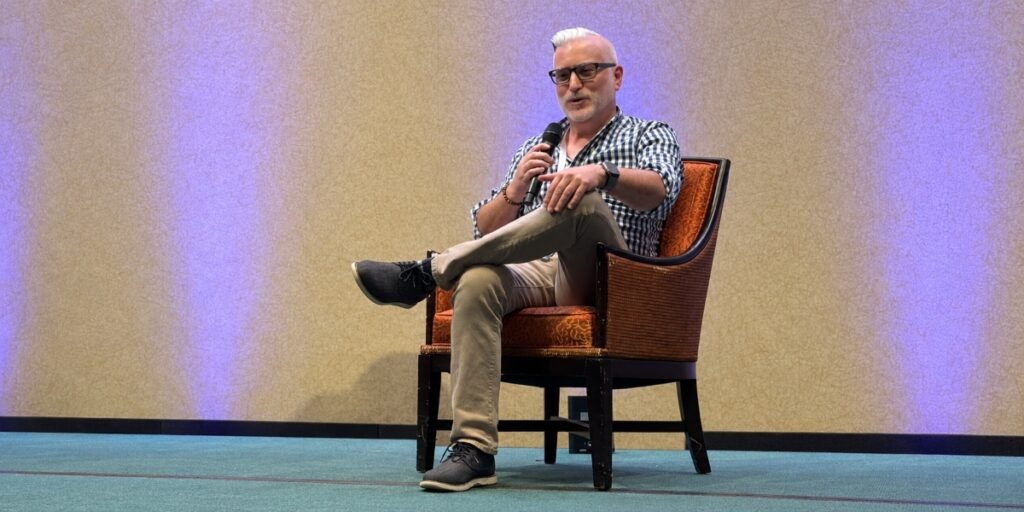



Some of the most important recent advances in technology have come from work in artificial intelligence, semiconductor engineering, and automation. One expert in these fields is Nicholas C. M. Fuller, a Trinidadian-American technology executive and research scientist. His career includes experience in semiconductor manufacturing, cloud and edge computing, and enterprise AI at IBM.
Fuller was born in Trinidad and Tobago on 14 July 1974, an era when high-technology computing was still not readily available in the Caribbean. He first got acquainted with science and technology through his school teachers, science programs on international TV networks, and his childhood curiosity.
Fuller attended Fatima College, where his first hands-on experience with computers came in his school’s computer lab. He later moved to the United States and began studying at Morehouse College, where he majored in Physics and Mathematics. He graduated summa cum laude, with the highest academic honor, in 1997.
Fuller received master of Science and a Ph.D. degree, the latter with distinction, in Applied Physics at Columbia University. During his doctoral studies, he also spent some time as a co-matriculate with Bell Laboratories, renowned for its important research in semiconductor physics, telecommunications, and materials science.
Fuller became an IBM Researcher at the Thomas J. Watson Research Center in 2002. His initial research work was done in the fields of semiconductor devices and interconnect technologies, essential for advanced microelectronics devices. In that time, the semiconductor industry was moving through its successive generation of smaller CMOS technology nodes, driving the need for innovation in fabrication processes, device architecture, and manufacturing yield optimization.
Fuller has assisted with research related to semiconductor scaling from the 90-nanometer node to the 22-nanometer node. Each generation of technology had to address various challenges associated with increased transistor density, interconnect reliability, and process integration issues. His research focused on manufacturing solutions for advanced CMOS technologies to enhance fabrication efficiency, driving enhanced device performance and reliability.
Further to his research on semiconductors, Fuller’s area of interest in enterprise computing grew to encompass cloud computing and enterprise software systems. Later, he guided teams in hybrid cloud platforms, software asset management, analytics, and IT services technologies. This was part of a larger trend in the technology sector: the rise of the distributed computing environment, virtualization, and automation in enterprise architecture strategies.
In the latter domain, Fuller drove work in AI-driven IT services, which involves utilizing machine learning, predictive analytics, and automation tools for various build and runtime use cases.
Fuller also contributed to developing edge computing research strategies, which seek to process data at the edge, or near the device and network endpoint, rather than completely in the cloud. During his career at IBM, Fuller worked in multiple research and executive positions, including Director and Vice President.
He spearheaded research agendas for enterprise modernization, automation software, cloud solutions, and AI integration. His most recent leadership roles have involved working with product development teams to develop agentic AI systems for IBM’s enterprise automation software portfolio.
These technologies include autonomous or semi-autonomous software agents that can perform tasks, make decisions, and coordinate workflows with human in-the-loop interaction. This field of research has gained more significance in enterprise software engineering, industrial automation, cybersecurity operations, IT automation, and business process management.
Fuller has also collaborated with corporate clients regarding future AI deployment strategies and modernization initiatives. He provides guidance to organizations in areas of AI integration in enterprise systems, workflow automation, and software engineering processes. With the use of generative and autonomous AI technologies, concerns about how to govern AI, its operational scalability, and the reliability of AI automation are growing in importance across industry conversations.
Fuller has received two IBM Master Inventor awards and has more than 75 patents. He is also the co-author of 80 technical publications on semiconductors, cloud technologies, AI systems, and enterprise automation. His publications have been cited thousands of times in academic literature, applied research, and industrial technology.
His insights and contributions have been featured in technology and business journals, including Forbes and TechRadar, focusing on trends in AI strategy, edge computing, and enterprise automation. He has also served in an advisory capacity with various organizations in industry, such as the ASCET Center of Excellence advisory board.
While not within the confines of his technical leadership, Fuller has continued to work as an active mentor and advocate for STEM. He has worked with the University of the West Indies, the National Society of Black Engineers, students, and interns. His coaching is integrated into an increased focus on science, engineering, and technology careers for younger generations.