


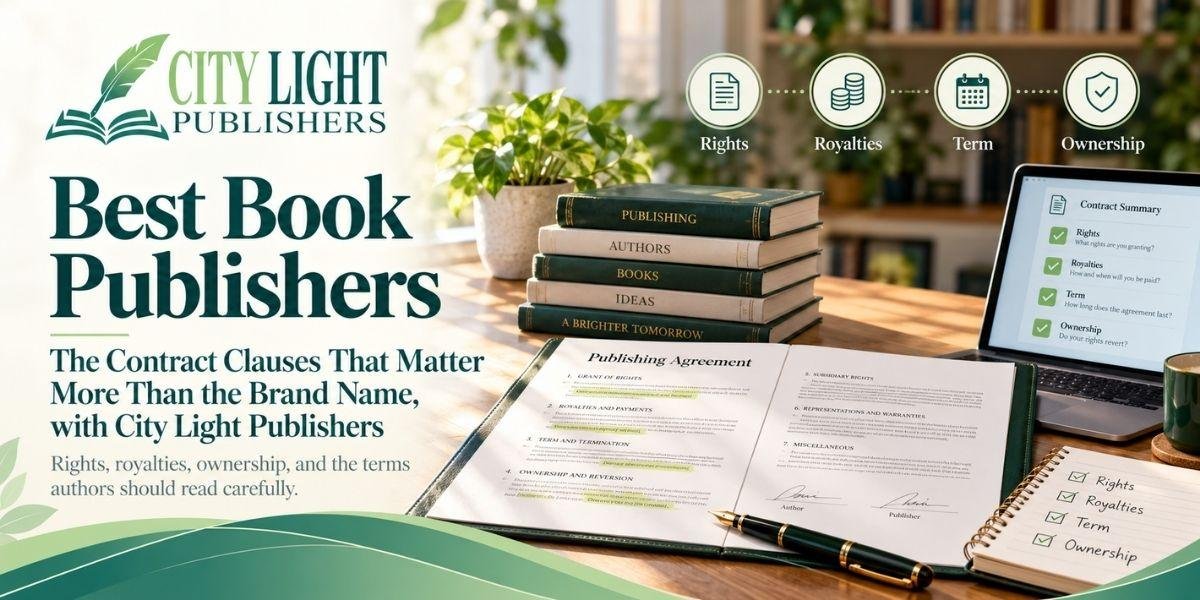
Authors comparing the different book publishers tend to compare reputations. The more useful comparison is of paperwork, because two companies with identical marketing can offer agreements that differ enormously in what the author walks away owning.
Six clauses do most of the work. An author who reads only these six, in any publishing agreement, will avoid the great majority of the problems this industry produces.
1. The Grant Of Rights
The first question in any publishing contract: what exactly are you giving away, and is anything left?
Read for scope (which formats: print, ebook, audio, film, merchandise, translation), territory (which countries, and in which languages), and exclusivity (whether the grant prevents you from using the work elsewhere).
The spectrum runs from a narrow grant of print rights in one territory, with everything else retained, to a full assignment of all rights in all formats and languages worldwide.
City Light Publishers’ stated position is at the opposite end from an assignment: authors “retain 100% ownership, rights, and royalties,” with the company providing services rather than acquiring the work. Whatever the model, the grant clause is where the reality sits, and it should match what you were told in conversation.
2. Term And Reversion
How long the agreement lasts, and how it ends.
Traditional contracts commonly run for the life of copyright, with rights returning to the author only when the book falls out of print. That definition mattered when print runs ended; in an era where digital editions never technically go out of print, an out-of-print clause without a sales threshold can mean rights never revert at all.
What to look for: a defined term, or an out-of-print definition tied to actual sales over a period, plus a reversion process the author can trigger in writing.
In a service arrangement, where no rights are transferred, this clause should be simple or absent. If it is neither, ask why.
3. How Royalties Are Calculated
Not the percentage, but the base.
A royalty on list price is calculated on the cover price. A royalty on net receipts is calculated on what the publisher actually receives after retailer discounts, which can be a substantially smaller number. A high percentage of net can be worth less than a lower percentage of a list.
Also check: whether the rate differs by format and channel, whether it changes at sales thresholds, and how returns and reserves against returns are handled in print.
In a service model, the author receives the retailer’s royalty directly, which removes most of this complexity but it makes the account ownership question below the critical one.
4. Who Holds The Retailer Accounts
This clause is often absent, which is itself the problem.
If the book is published through accounts held by the company, the author cannot change the price, revise the description, update categories, or move the title without the company’s cooperation, regardless of what the rights clause says. Practical control and legal ownership come apart at exactly this point.
The right arrangement is accounts in the author’s name with access granted to the publisher. Ask for it explicitly and get the answer in writing.
5. The Option And Non-Compete Clauses
Two clauses that reach beyond the book in front of you.
An option clause gives the publisher first look at your next work, sometimes on terms set in advance. A broad option can tie up years of future writing.
A non-compete restricts you from publishing similar work elsewhere during the term. Written loosely as “any work on a similar subject” can prevent an expert from writing in their own field.
Both are negotiable, and both should be narrowed to something specific and time-limited if they appear at all.
6. Files, Assets And What You Leave With
The clause authors discover they need only when the relationship ends.
You should leave with the manuscript in an editable format, the cover in layered source files, the print-ready interior PDF, the audiobook masters if audio was produced, and any website files and accounts. Flattened outputs only are the mark of a company making it expensive to work with anyone else.
City Light Publishers states that authors retain full ownership across its services; for any provider, confirm that ownership includes the working files, not only the published result.
Reading The Rest Of It
Beyond the six, three habits help.
Match the document to the conversation. If a salesperson describes something that does not appear in the agreement, it is not part of the deal. Ask for it to be added.
Treat marketing promises with care. No company can guarantee press coverage, bestseller status, or specific sales. Language committing to outcomes rather than activities should be read sceptically wherever it appears.
Have it reviewed. A publishing lawyer’s fee is small relative to the value of rights in a book that works, and the review usually takes an hour.
What Track Record Contributes
Company history is worth checking but does not substitute for the clauses.
City Light Publishers reports operating since 2009 with more than 500 in-house staff and over 10,000 books published company-provided figures, which prospective clients should treat as claims and verify the way they would with any vendor: references in a comparable genre, published titles examined directly, sample pages read, listings inspected.
A long track record and a bad contract is still a bad contract. A new company and a clean one may serve you better.
The One-Paragraph Version
Read the grant of rights, the term and reversion, the royalty base, the account ownership, the option and non-compete, and the file handover. Make sure the document says what the conversation said. Have a lawyer look at it.
Do that, and the question of which book publishers are worth considering largely answers itself, because the companies worth working with are the ones whose paperwork matches their pitch.
City Light Publishers describes its publishing model at City Light Publishers.