



As-is means the seller makes no repairs, not that the buyer never looks at the house. A HomeWise inspection in the ordinary sense of the word does not happen. The company walks the property once to confirm the condition already described and priced: roof, foundation, systems, and whatever photographs did not show. It is a condition check, not a financed buyer’s contingency.
Take a hypothetical owner in Jacksonville, Florida, with a 1968 concrete block house and a ceiling stain she photographed honestly in April 2026. The offer came back at $196,000, built on a $14,000 roof replacement and a $6,000 allowance for water damage below it. At the walkthrough, the buyer’s project manager pulled back a corner of carpet and found the subfloor gone soft across two rooms, roughly $9,000 of work nobody had priced. The figures are illustrative, but the situation is ordinary. The house was worse than the pictures the number was built on.
What Does a Home Inspection Do That an As-Is Walkthrough Does Not?
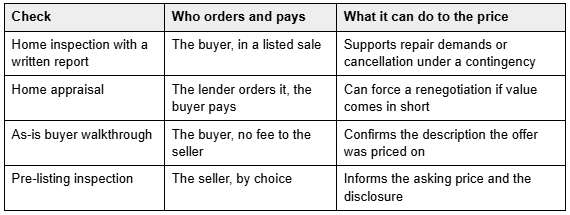
A home inspection is a defined product with a written standard behind it. The American Society of Home Inspectors, a professional society established in 1976, publishes the standard that many state licensing rules borrow from. Its standard of practice draws the boundaries plainly. An inspection performed under that standard is meant to tell the client about the condition of the systems and components inspected, as they stood on the day of the visit. The same document is explicit that the inspector is “NOT required to determine methods, materials, or costs of corrections.”
That last line is the whole difference. An inspector reports; the client decides what to do about it. A direct buyer has the opposite job. It is pricing the corrections, because it will pay for them after closing, and it is checking one thing only, whether the house in front of it matches the house it priced. No report goes to the seller, and no repair list follows.
Sellers searching for homeowner inspection cost are pricing a service that does not appear in an as-is sale at all. In a listed sale, the buyer hires the inspector and pays the fee, and the seller absorbs the consequences in the form of repair credits. In a sale to a direct buyer, nobody orders that report, so there is no fee and no credit request to argue over.

Is a Walkthrough the Same as an Appraisal?
No, and the federal government draws the line in writing. The Department of Housing and Urban Development’s page for FHA Roster Appraisers describes what an appraiser does, then adds the caveat that an appraiser’s observation is limited to “readily observable conditions” and is not as thorough as an inspection performed by a licensed home inspector. A home appraisal exists to give a lender an opinion of value. A cash purchase has no lender, so none is ordered, and the buyer’s own visit carries weight that two outside parties would otherwise share.
What Happens When the House Does Not Match the Description?
This is the part sellers are right to ask about, because a walkthrough can be used honestly or used as a setup. The honest version works in a set order.
• The offer is built on what the seller described. Photos, answers about the roof and the systems, and any known problem the owner named.
• The visit confirms or corrects that description. One visit, usually within a few days of first contact, covering roof, foundation, plumbing, electrical, water intrusion, occupancy, and access.
• A match means the number stands. Nothing new is found, and the price the seller was quoted is the price at closing.
• A material difference is shown, not asserted. A buyer that wants to move the number should show the line it missed and what it costs, the way it showed the original math.
• Any change is agreed in writing or not at all. A signed contract is changed by amendment, and the seller is free to decline and hold the buyer to the agreed price.
The pattern to watch for is the reverse: a thin offer, a quick signature, then a discovery days before closing that shaves tens of thousands off the price. Buyers such as HomeWise publish an inspection period in the contract and describe the obligation to close at the agreed price as remaining firm through it. That term, and how tightly it is written, is what separates a firm offer from a soft one.
Timing is the reason the walkthrough is brief. According to the National Association of Realtors’ existing-home sales report for July 2026, released on August 11, 2026, homes that sold that month spent a median of 29 days on the market, and that clock starts before a financed buyer’s inspection period even begins. A cash purchase compresses the same ground into days, which only works if the condition question is settled in a single visit.

Where Does a Direct Buyer Fit?
HomeWise, a direct home-buying company that purchases distressed single-family houses in California, Texas, Florida, Arizona, Georgia and other states, buys as-is with no repairs, cleaning, staging or showings required, and prices from the condition it observes: roof, foundation, layout, systems, damage, occupancy and access. Its published guide to the cash offer process describes the evaluation as an in-person walk-through, a review of seller photos, or an analysis of public records and comparable sales, and states plainly that it is not a traditional home inspection with a written report and a list of repair demands.
The company’s explanation of how the process works reports offers in as little as one hour and closings in as few as seven days once title is clear, with a closing date the seller can push out as far as 60 days. That same page lists the condition items an offer is built from before any visit takes place.
Frequently Asked Questions
Is it possible to sell a home as is without an inspection?
Yes, in the sense that matters: no seller-paid inspector, no written report, and no repair list. A direct buyer still looks at the house, usually once, and prices what it sees. The seller supplies access and an honest description, and repairs stay with the buyer after closing.
Does a cash buyer order a home appraisal?
Normally not. An appraisal is a lender requirement, and a buyer using its own money has no lender to satisfy. Some buyers pull an internal valuation from comparable sales, which is not an appraisal and never becomes a contingency the seller has to clear before closing.
What if the walkthrough turns up something the photos did not show?
The buyer may ask to revise the price or the terms, and the seller may decline. Nothing changes without a written amendment that both sides sign. Sellers who describe known problems up front, in writing, leave far less room for a late discovery to become a bargaining chip.
How long does the visit take, and who attends?
Usually under an hour, and often less on a small single-family house. A staff member or a contractor working for the buyer walks the rooms, the exterior, the attic access and the mechanical equipment. Occupied houses take longer, since the people living there need notice first.
Disclaimer: This article is provided for general informational and educational purposes only and should not be considered legal, financial, real estate, appraisal, or inspection advice. References to HomeWise, its purchasing process, timelines, offers, and property evaluation practices are based on publicly available company materials and should not be interpreted as independently verified guarantees or representations of results in every transaction. Any examples, property values, repair estimates, and scenarios presented are illustrative unless otherwise stated. Real estate transactions, inspection requirements, disclosure obligations, contract terms, and seller rights vary by property, jurisdiction, and individual circumstances. Sellers should review all agreements carefully and consult qualified real estate, legal, tax, or other appropriate professionals before making decisions regarding the sale of a property.