



For self-employed individuals looking to make a substantial tax-deductible retirement contribution for 2025, September 15 is a date that appears almost everywhere.
Search for the deadline to fund a Defined Benefit Plan or Cash Balance Plan, and September 15 is commonly presented as the final date for a calendar-year plan. For many businesses and many pension plans, that is correct.
But for certain sole proprietors who have extended their 2025 individual tax returns, September 15 may not necessarily mean the end of the opportunity.
Depending on how the retirement plan is structured, some sole proprietors may still have an opportunity to establish and fund a Defined Benefit or Cash Balance Plan for 2025 before the October 15, 2026 extended tax-filing deadline.
That distinction could be particularly important for self-employed professionals and business owners who discover late in the year that they are facing a significant 2025 tax liability.
Why September 15 Is Usually Considered the Deadline
The September 15 date is not arbitrary.
Under Internal Revenue Code Section 430, the deadline for paying a minimum required contribution to a single-employer Defined Benefit Plan is generally 8½ months after the close of the plan year. For a traditional calendar-year plan ending December 31, that produces a September 15 funding deadline.
That is why September 15 appears so frequently in articles discussing Defined Benefit and Cash Balance Plan contribution deadlines.
However, the plan-year funding deadline is only one part of the analysis.
Another important date is the employer’s tax-return filing deadline.
Sole Proprietors Can Have an October 15 Tax-Filing Deadline
A sole proprietorship generally reports its business income on Schedule C as part of the owner’s individual Form 1040.
For the 2025 tax year, an individual who timely requested an extension has until October 15, 2026 to file the federal income-tax return. The IRS specifically identifies October 15, 2026 as the filing deadline for individuals whose 2025 Forms 1040 are on extension.
This matters because changes made by the SECURE Act significantly expanded the ability of businesses to establish retirement plans after the end of a tax year.
The SECURE Act Changed the Retirement Plan Deadline
Before the SECURE Act, employers generally had to establish a qualified retirement plan by the end of the year for which they wanted the plan to be effective.
The SECURE Act changed that rule.
The IRS explains that an employer may generally adopt a qualified retirement plan by the due date of its tax return, including extensions, and elect to treat the plan as having been adopted as of the last day of the prior tax year. The IRS specifically notes that this rule applies to Defined Benefit Plans as well as other qualified retirement plans.
This created an important planning opportunity for business owners who do not begin evaluating a retirement plan until after the tax year has already ended.
It also creates an important distinction between the deadline to establish a plan, the deadline to fund a Defined Benefit Plan, and the deadline to claim the related tax deduction.
Those dates do not always have to be identical.
September 15 Does Not Tell the Entire Story
For a conventional calendar-year Defined Benefit or Cash Balance Plan, September 15 remains an extremely important funding deadline.
But that does not necessarily mean every sole proprietor who reaches September 16 without a pension plan has permanently lost the opportunity to establish a plan for the prior tax year.
In certain circumstances, appropriate pension plan design can provide additional time.
The availability of this opportunity depends on factors including the employer’s tax status, whether the tax return has been extended or already filed, when the plan is established, the applicable plan year, the required contribution, and the specific design of the pension plan.
This is why simply searching for “Cash Balance Plan contribution deadline” can produce an incomplete answer.
The standard September 15 rule may be correct for the standard plan being described. It does not necessarily address every plan design available to a sole proprietor.
Why This Matters for High-Income Self-Employed Individuals
The distinction can be particularly valuable for high-income professionals and independent business owners.
Physicians, consultants, attorneys, real estate professionals, technology contractors and other self-employed individuals sometimes do not know their final income or tax liability until their CPA completes much of the tax return.
By September, they may discover that their taxable income is substantially higher than expected.
At that point, they may start researching Defined Benefit or Cash Balance Plans only to encounter repeated references to September 15 as the final deadline.
For some sole proprietors, stopping the analysis there could mean overlooking a legitimate retirement and tax-planning opportunity.
A properly designed Defined Benefit or Cash Balance Plan can potentially allow a qualifying business owner to make a retirement contribution substantially larger than the amount available through a traditional IRA or 401(k) alone. The actual contribution is determined actuarially and depends on factors such as age, compensation, plan provisions, interest assumptions and applicable IRS limitations.
Do Not Wait Until October 15 to Begin the Analysis
October 15 should not be viewed as a reason to delay.
Establishing a Defined Benefit or Cash Balance Plan requires plan design, actuarial calculations, preparation and execution of plan documents, and coordination with the business owner’s CPA and investment provider.
In addition, the October 15 opportunity is not available in every situation.
A sole proprietor considering a pension plan after September 15 should therefore have the situation reviewed as quickly as possible rather than assuming either that the opportunity has disappeared or that October 15 automatically applies.
Pension Deductions Cash Balance Plan Calculator
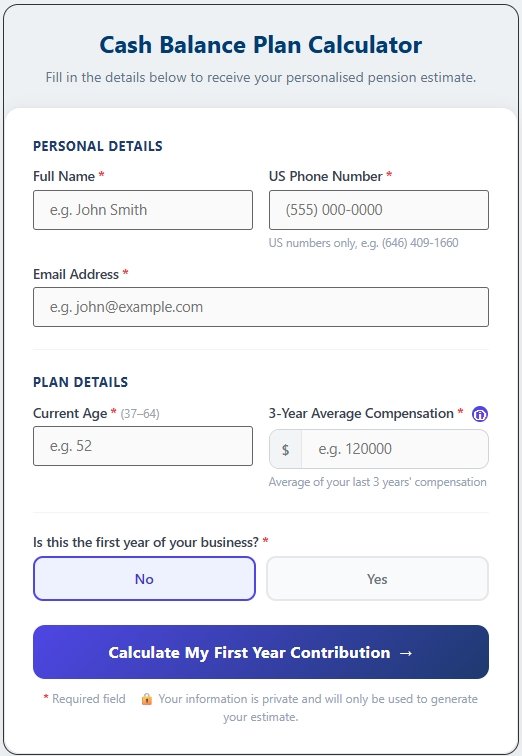
Business owners who want an initial estimate of how much they may be able to contribute can use the Pension Deductions Cash Balance Plan Calculator. The calculator provides an instant estimate based on factors such as age and compensation and can help illustrate the potential contribution range before a formal actuarial analysis is completed. It is a useful starting point for sole proprietors and small-business owners evaluating whether a Cash Balance Plan may fit their tax and retirement-planning goals.
The Bottom Line
September 15 is an important Defined Benefit Plan and Cash Balance Plan funding deadline, but it should not automatically be interpreted as the end of pension planning for every sole proprietor.
For a sole proprietor who timely extended a 2025 Form 1040 to October 15, 2026 and has not yet filed the return, there may still be an opportunity to establish and fund a retirement plan for 2025, depending on the circumstances and how the plan is structured.
Business owners who believe they have missed the September 15 deadline should have their individual situation reviewed before concluding that it is too late.
Pension Deductions specializes in the design and administration of Defined Benefit, Cash Balance, Profit Sharing and 401(k) retirement plans for self-employed individuals and small-business owners. Sole proprietors who have extended their 2025 tax returns can contact Pension Deductions to determine whether a 2025 pension plan opportunity may still be available before the October 15 deadline.
Contact Information
Email: info@pensiondeductions.com
Website: https://www.pensiondeductions.com/
Disclaimer: This article is for general informational purposes and should not be considered individualized tax, legal or investment advice. Retirement plan deadlines and contribution requirements depend on the specific facts and plan design.