


By: KeyCrew Media
A buyer sees a listing advertising an electric geothermal heat pump and reasonably concludes the home will be efficient and affordable to operate. That conclusion may be completely wrong, not because the equipment is faulty, but because no single component determines how much a home costs to run.
Why a Single Upgrade Doesn’t Make a High-Performance Home
Tim Stanislaus, who works with Pearl, argues that the real estate industry has trained buyers to evaluate homes as collections of discrete, visible features rather than as integrated systems, and that this habit sets buyers up for financial surprises after closing.
“You can have a high efficiency heat pump,” he says, “but if the ducts in the home are not sealed or if the building envelope of the home is compromised, there isn’t proper insulation in the home, it wasn’t built to the proper code, then that high efficiency heat pump is just going to run all day long and your utility bills are still going to be high.”
The problem is that a home’s energy performance depends on how insulation, duct sealing, air barriers, windows, and mechanical systems interact, not on any one component in isolation. A small gap in duct sealing, a section of under-insulated attic, or a building envelope that doesn’t meet current code can neutralize the benefit of an expensive, high-efficiency system upgrade.
“If one or more of those elements are missing, and they can be minor elements, it can still have a very large outsized impact on the performance of the home,” Stanislaus says.
What Listings Cannot Show
According to Stanislaus, current real estate listings are structurally incapable of surfacing systems-level information. Listings are built around aesthetics and condition, updated kitchens, bathroom counts, and roof age, not around how those elements interact to produce or undermine efficiency.
“The home operates as a system and not as a set of independent features,” Stanislaus says. “And this is another example of where current real estate data and current real estate listings can fall short of buyers’ needs.”
For buyers, this gap is asymmetric in its consequences. A buyer who overestimates a home’s efficiency based on one visible upgrade may not discover the error until months of unexpectedly high utility bills have accumulated. By then, the transaction is complete, and the leverage is gone.
Buyers currently have limited tools to close this gap on their own. Asking a seller for utility bills provides some information, but Stanislaus notes those figures reflect the previous occupants’ behavior, how many people lived there, and their habits, rather than the home’s inherent efficiency. A normalized metric, by contrast, holds occupant behavior constant so buyers can compare one home’s efficiency against another’s on equal terms.
Why Code Year Matters More Than Equipment Brand
According to Realtor.com research built on Pearl’s data, buyers of newly built homes save about $25,000 over their first 10 years of ownership compared with buyers of 20-year-old homes. Stanislaus says the largest driver of that gap is energy consumption differences rooted in the building code to which the home was originally constructed.
“Energy codes have been evolving in a very meaningful way within our building codes over the last 15 to 20 years,” Stanislaus says. A home built to modern code integrates efficiency at the structural level, envelope, insulation, and air sealing in ways that older homes often do not, regardless of what equipment has been retrofitted into them.
Regional variation compounds this effect. According to Stanislaus, Northeast homes tend to be older on average and more expensive to heat, which has driven stricter local energy codes. Sunbelt states, with newer construction booms and lower cooling costs, have generally adopted less aggressive standards, meaning buyers in those markets may encounter homes built to lower codes more frequently.
The practical takeaway for buyers: the year a home was built and the code it was built to are stronger predictors of operating costs than any single piece of equipment listed in the marketing materials.
Pearl’s Whole-System Approach
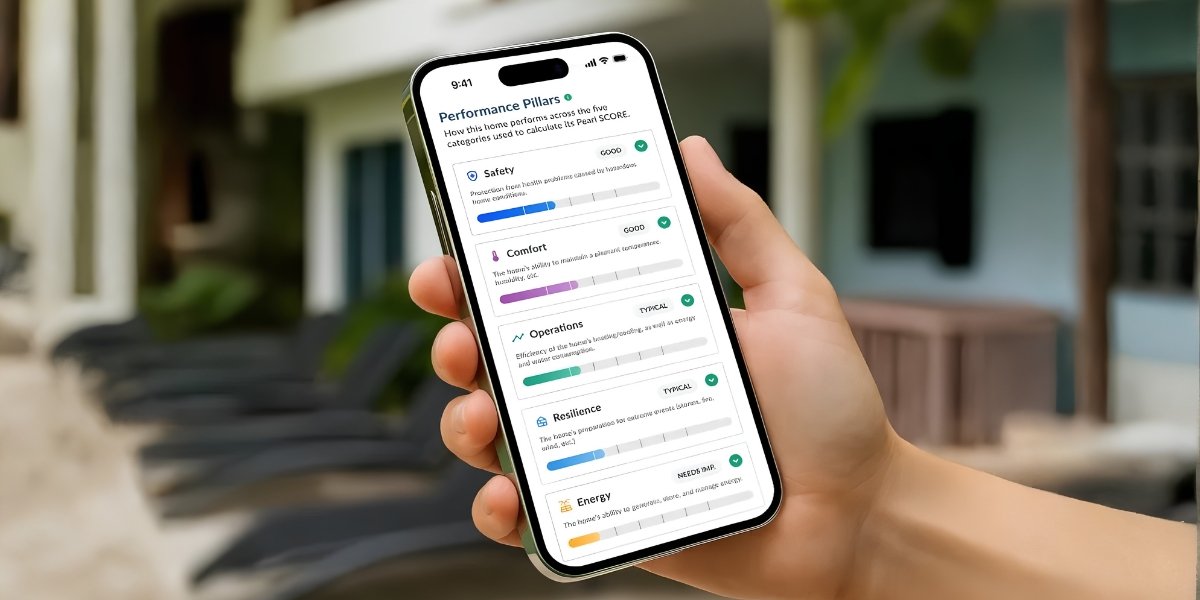
Pearl SCORE™ addresses this information gap by evaluating how a home’s components work together, insulation, air sealing, HVAC, and windows, to produce an overall performance outcome, rather than listing individual features. According to Pearl, the dataset covers 97 million U.S. homes.
The score is designed to give buyers a single comparable metric reflecting whole-system efficiency. Realtor.com‘s use of the framework in its total cost of ownership research reflects a broader industry shift toward systems-level home data, and Pearl SCORE™ is one resource among several emerging in this space for buyers seeking that kind of insight.
For buyers weighing two homes that look identical on paper, same price, same neighborhood, same square footage, systems-level data reveals differences that listings cannot. The home with the higher-efficiency heat pump may still cost more to operate if its envelope, ducts, or insulation underperform. Until that information becomes standard in listings, buyers who seek it out before making an offer will have a clearer picture of what ownership actually costs.
About Pearl: Founded in 2013, Pearl is a ratings and standards company focused on measuring how homes perform. Pearl SCORE™ rates every single-family home in the U.S. across five key pillars: Safety, Comfort, Operations, Resilience, and Energy, so home buyers, homeowners, and real estate professionals can understand how a home performs in daily life. As a Certified B Corporation, Pearl is accountable to its shareholders as well as to the homeowners and communities it serves. For more information, visit pearlscore.com.
Disclaimer: This article is based on information provided by the expert source cited above. It is intended for general informational purposes only and does not constitute legal, financial, or real estate advice. Readers should conduct their own research and consult qualified professionals before making any real estate or financial decisions.